
Choose by use case
If you wantPreschoolers ages 3+ who need one balanced full-size rainbow set
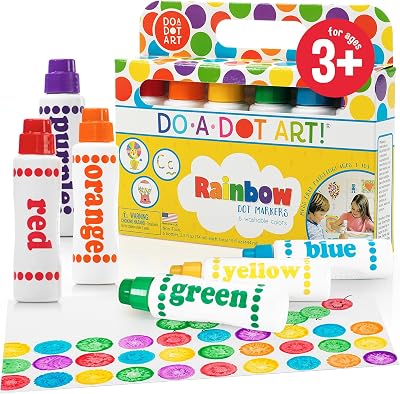
Do A Dot Art! Rainbow Washable Paint Markers, 6 Count
Best overallResearch-based reviewSix classic washable colors in easy-grip 2.5-ounce bottles with spill-resistant sponge tips
If you wantClosely supervised two-year-olds who need explicit current manufacturer age guidance

Chalkola Washable Dot Markers for Toddlers, 6 Count
Best for age 2+Research-based reviewSix chunky washable dot markers with a current maker-stated minimum of age 2 and printable activities
If you wantAges 3+ who benefit from an obvious page-and-marker starting point

Crayola Washable Dot Markers Activity Set
Best first activity kitResearch-based reviewFour full-size washable dot markers paired with 30 pages for letters, numbers, colors and shapes
If you wantPreschoolers who want more shades without an oversized activity bundle

Shuttle Art Washable Dot Markers, 15 Colors
Best color rangeResearch-based reviewFifteen washable colors in compact bottles with access to downloadable pattern pages
If you wantSiblings, preschool groups and families that want many prepared pages

Shuttle Art Dot Markers with Five Activity Books, 14 Colors
Best big activity bundleResearch-based reviewFourteen washable dot markers with five themed books containing 135 patterns
If you wantAges 3+ who repeatedly use a small core palette

Jar Melo Washable Dot Markers for Toddlers, 6 Colors
Best large-capacity kitResearch-based reviewSix 60 mL washable dot markers with 10 printed sheets and a downloadable activity library
If you wantAges 3+ adding sparkle accents after buying a standard rainbow set

Do A Dot Art! Ultra Bright Shimmer Dot Markers, 5 Count
Best shimmer setResearch-based reviewFive pastel-bright shimmer colors in the same full-size washable Do A Dot format
Product comparison
| Product | Best for | Watch out | Price & shop |
|---|---|---|---|
| Do A Dot Art! Rainbow Washable Paint Markers, 6 Count (opens Amazon in a new tab) Best overallResearch-based review | Preschoolers ages 3+ who need one balanced full-size rainbow set | It is not labeled for children under 3, and six dot colors cannot make narrow lines or cover every ordinary coloring-book job | |
| Chalkola Washable Dot Markers for Toddlers, 6 Count (opens Amazon in a new tab) Best for age 2+Research-based review | Closely supervised two-year-olds who need explicit current manufacturer age guidance | A 2+ label does not make caps, mouthing, wet ink or off-paper stamping safe without an adult beside the child | Budget-friendlyCheck price on Amazon (opens Amazon in a new tab) |
| Crayola Washable Dot Markers Activity Set (opens Amazon in a new tab) Best first activity kitResearch-based review | Ages 3+ who benefit from an obvious page-and-marker starting point | Four colors limit open-ended pictures, and the value of the kit drops after the 30 consumable pages are finished | |
| Shuttle Art Washable Dot Markers, 15 Colors (opens Amazon in a new tab) Best color rangeResearch-based review | Preschoolers who want more shades without an oversized activity bundle | The current maker and Amazon pages market the set to toddlers and preschoolers but do not state a precise minimum age, and each compact bottle holds much less ink than a full-size marker | Budget-friendlyCheck price on Amazon (opens Amazon in a new tab) |
| Shuttle Art Dot Markers with Five Activity Books, 14 Colors (opens Amazon in a new tab) Best big activity bundleResearch-based review | Siblings, preschool groups and families that want many prepared pages | It needs much more storage than a six-marker starter set, can overwhelm a new user and lacks a precise published minimum age on the current pages | |
| Jar Melo Washable Dot Markers for Toddlers, 6 Colors (opens Amazon in a new tab) Best large-capacity kitResearch-based review | Ages 3+ who repeatedly use a small core palette | Six large bottles are bulky in a travel bag, and the basic palette offers less color choice than the Shuttle Art alternatives | |
| Do A Dot Art! Ultra Bright Shimmer Dot Markers, 5 Count (opens Amazon in a new tab) Best shimmer setResearch-based review | Ages 3+ adding sparkle accents after buying a standard rainbow set | The five-color pastel shimmer palette omits several basic rainbow colors and should be treated as an add-on rather than a child's first dot-marker box |
How we researched this guide
- Product listings checked
- Hands-on testing
- None of the 7 picks — all are research-based
- Labels explained
- How we test and label products
This is a research-based buying guide, not a hands-on toddler-use or stain test. On September 8, 2026, we opened the exact Amazon.com detail page for every recommendation in a US delivery context, confirmed its ASIN, found a current in-stock offer with add-to-cart and buy-now controls, and matched the selected variant to its direct high-resolution Amazon CDN image. We cross-checked age guidance, count, bottle format, included pages, washable claims and safety statements against current Do A Dot Art, Crayola, Chalkola, Shuttle Art and Jar Melo sources. We favored sets that solve distinct jobs without turning small differences into invented performance rankings. We did not give these markers to children, measure grip comfort, dot diameter, ink capacity beyond documented specifications, drying time, leakage, bleed-through, color strength, cap fit or stain removal. Cleanup and ease of use depend on the exact formula, surface, paper, child and supervision, so all recommendations remain explicitly research-based.
Testing status by pick
- Do A Dot Art! Rainbow Washable Paint Markers, 6 CountResearch-based review
- Chalkola Washable Dot Markers for Toddlers, 6 CountResearch-based review
- Crayola Washable Dot Markers Activity SetResearch-based review
- Shuttle Art Washable Dot Markers, 15 ColorsResearch-based review
- Shuttle Art Dot Markers with Five Activity Books, 14 ColorsResearch-based review
- Jar Melo Washable Dot Markers for Toddlers, 6 ColorsResearch-based review
- Do A Dot Art! Ultra Bright Shimmer Dot Markers, 5 CountResearch-based review
Product details and drawbacks
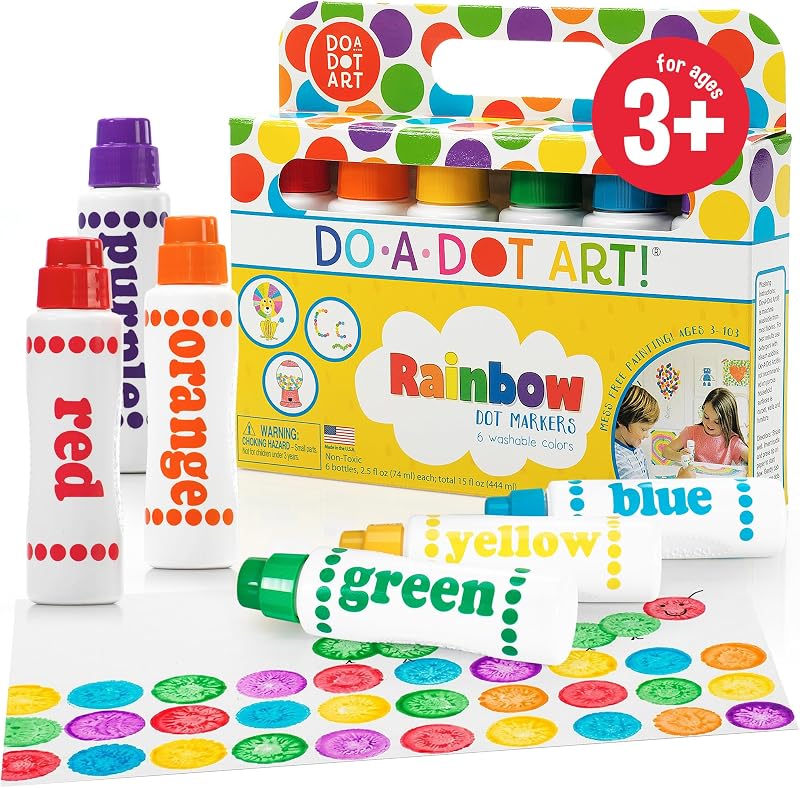
Do A Dot Art! Rainbow Washable Paint Markers, 6 Count (opens Amazon in a new tab)
Six classic washable colors in easy-grip 2.5-ounce bottles with spill-resistant sponge tips
Why it fits this guide
The Rainbow 6 set covers the most common first activities without asking a child to manage a huge palette. Red, orange, yellow, green, blue and purple work for color matching, simple patterns, letters and open-ended pictures. Do A Dot Art publishes a clear ages-3+ minimum, a washable dye-based formula and ASTM D-4236 conformance. The full-size bottles are deliberately shaped for little hands, and the sponge tip keeps paint in the marker rather than an open cup.
Honest drawback
It is not labeled for children under 3, and six dot colors cannot make narrow lines or cover every ordinary coloring-book job
Specifications
- Exact Rainbow 6 Amazon ASIN was in stock in a US delivery context on September 8, 2026
- Six classic colors in 2.5-ounce bottles
- Do A Dot Art specifies ages 3+ with supervision and ASTM D-4236 conformance
Best forPreschoolers ages 3+ who need one balanced full-size rainbow set
Pros
- Useful first rainbow palette
- Full-size easy-grip bottles
- Spill-resistant sponge tips require no paint cups or brushes
Cons
- Not labeled for children under 3
- Specialized tips cannot draw fine lines
Chalkola Washable Dot Markers for Toddlers, 6 Count (opens Amazon in a new tab)
Six chunky washable dot markers with a current maker-stated minimum of age 2 and printable activities

Why it fits this guide
Age guidance is the deciding feature here. Chalkola's current product page specifically states ages 2+, while the other clearly dated products in this guide begin at 3 or leave the minimum unclear. Six bright colors keep the first setup small, and the maker provides downloadable pages built around standard dot activities. This is a better evidence match for a two-year-old than relying on a vague toddler phrase elsewhere.
Honest drawback
A 2+ label does not make caps, mouthing, wet ink or off-paper stamping safe without an adult beside the child
Specifications
- Exact six-count Amazon ASIN was in stock in a US delivery context on September 8, 2026
- Six washable water-based dot markers with chunky barrels
- Chalkola's current product page specifies ages 2+ and downloadable activity pages
Best forClosely supervised two-year-olds who need explicit current manufacturer age guidance
Pros
- Clearest current age fit for supervised two-year-olds
- Manageable six-color palette
- Printable pages support simple first activities
Cons
- Still demands direct adult supervision
- Smaller palette than preschool-focused sets
Crayola Washable Dot Markers Activity Set (opens Amazon in a new tab)
Four full-size washable dot markers paired with 30 pages for letters, numbers, colors and shapes

Why it fits this guide
This set removes the blank-page problem. The 30 included pages give a preschooler large, recognizable targets from the first session, and four colors keep the table simple. Crayola publishes the exact item number, marker volume, activity count, ages-3+ guidance and a formula-specific washability claim covering skin, most washable clothing and most painted walls. It is the easiest gift when the adult does not want to find or print separate dot pages.
Honest drawback
Four colors limit open-ended pictures, and the value of the kit drops after the 30 consumable pages are finished
Specifications
- Exact Crayola item 811494 Amazon ASIN was in stock in a US delivery context on September 8, 2026
- Four 2.5-ounce washable dot markers and 30 activity pages
- Crayola specifies ages 3+
Best forAges 3+ who benefit from an obvious page-and-marker starting point
Pros
- Complete first activity in one box
- Low color count is easy to manage
- Manufacturer publishes precise cleanup and age guidance
Cons
- Only four colors
- Included pages are consumable
Shuttle Art Washable Dot Markers, 15 Colors (opens Amazon in a new tab)
Fifteen washable colors in compact bottles with access to downloadable pattern pages

Why it fits this guide
Shuttle Art 15 is the palette upgrade. It adds intermediate colors, neutrals and black without requiring five physical books or a classroom quantity. The compact 0.42-ounce bottles are lighter and take less room than the full-size alternatives, so the set suits a child who values choice more than maximum ink per color. A QR card links to printable dot patterns when a blank sheet feels too open-ended.
Honest drawback
The current maker and Amazon pages market the set to toddlers and preschoolers but do not state a precise minimum age, and each compact bottle holds much less ink than a full-size marker
Specifications
- Exact 15-color Amazon ASIN was in stock in a US delivery context on September 8, 2026
- Fifteen washable colors in compact 0.42-ounce bottles
- Downloadable patterns are available through the included QR card
Best forPreschoolers who want more shades without an oversized activity bundle
Pros
- Broadest marker-only palette in this guide
- Compact bottles are light and space-efficient
- Includes access to printable pattern activities
Cons
- No precise minimum age on current pages
- Less ink per color than full-size bottles
Shuttle Art Dot Markers with Five Activity Books, 14 Colors (opens Amazon in a new tab)
Fourteen washable dot markers with five themed books containing 135 patterns

Why it fits this guide
The five books make this the most substantial ready-to-use library in the guide. Their themes include letters, numbers, animals, foods and vehicles, so an adult can choose a page that matches the child's current interest. Fourteen colors add enough variety for matching and repeating patterns. The bundle makes most sense when several children will share it or when dot pages are already a proven favorite.
Honest drawback
It needs much more storage than a six-marker starter set, can overwhelm a new user and lacks a precise published minimum age on the current pages
Specifications
- Exact 14-marker and five-book Amazon ASIN was in stock in a US delivery context on September 8, 2026
- Five themed books contain 135 activity patterns
- Fourteen washable colors with ASTM D-4236-conforming ink according to Shuttle Art
Best forSiblings, preschool groups and families that want many prepared pages
Pros
- Large library of immediately usable pages
- Enough colors for matching and varied pictures
- Practical for siblings or small groups
Cons
- Bulky for one occasional user
- No precise minimum age on current pages
Jar Melo Washable Dot Markers for Toddlers, 6 Colors (opens Amazon in a new tab)
Six 60 mL washable dot markers with 10 printed sheets and a downloadable activity library

Why it fits this guide
Jar Melo keeps the palette simple while emphasizing capacity. Each current listing bottle holds 60 mL, or 2.1 fluid ounces, which is close to a full-size Do A Dot or Crayola bottle and far more than the compact Shuttle Art 15 markers. Ten physical pages make the set usable immediately, while the downloadable library extends it. Jar Melo's current site places its washable dot markers in the 3+ range.
Honest drawback
Six large bottles are bulky in a travel bag, and the basic palette offers less color choice than the Shuttle Art alternatives
Specifications
- Exact six-color Amazon ASIN was in stock in a US delivery context on September 8, 2026
- Six 60 mL (2.1-fluid-ounce) dot markers
- Ten physical activity sheets plus downloadable pages; current Jar Melo guidance is 3+
Best forAges 3+ who repeatedly use a small core palette
Pros
- Large ink capacity per color
- Printed and downloadable activities
- Six-color setup remains manageable
Cons
- Bulky for travel
- Limited palette
Do A Dot Art! Ultra Bright Shimmer Dot Markers, 5 Count (opens Amazon in a new tab)
Five pastel-bright shimmer colors in the same full-size washable Do A Dot format

Why it fits this guide
Ultra Bright Shimmer changes the finish without changing the familiar press-and-lift motion. Aqua, yellow, lavender, coral and magenta are well suited to cards, flowers, mermaids and seasonal pictures. The bottles retain the full-size 2.5-ounce format and the maker's 3+ supervision guidance. It is the strongest specialty choice here because the effect is visibly different, not because it performs ordinary rainbow jobs better.
Honest drawback
The five-color pastel shimmer palette omits several basic rainbow colors and should be treated as an add-on rather than a child's first dot-marker box
Specifications
- Exact Ultra Bright Shimmer five-pack Amazon ASIN was in stock in a US delivery context on September 8, 2026
- Five colors in full-size 2.5-ounce bottles
- Do A Dot Art specifies ages 3+ with supervision
Best forAges 3+ adding sparkle accents after buying a standard rainbow set
Pros
- Distinct shimmer finish for cards and accents
- Full-size easy-grip bottles
- Uses the same spill-resistant sponge-tip format as the Rainbow set
Cons
- Incomplete palette for a first set
- Only five colors
Corrections
Spotted an error or outdated detail? Read how we handle corrections.
Related guides
25 Easy Rainy Day Crafts for Kids
Twenty-five easy rainy day crafts for kids using paper, cardboard, crayons, washable paint, yarn and clean recyclables, with simple steps and safety notes.
Best Coloring Supplies for Kids
The best coloring supplies for kids, from washable markers and crayons to no-sharpen pencils, easy-grip paint sticks and fun dot markers.
Best Washable Markers for Kids
Ten research-based washable marker sets for kids, compared by tip style, barrel size, color range, age guidance and realistic cleanup claims.
Best Mess-Free Coloring Supplies for Travel, Restaurants and Planes
Seven research-based mess-free coloring picks for planes, restaurants and road trips, compared by cleanup, portability, replay value and age guidance.


