
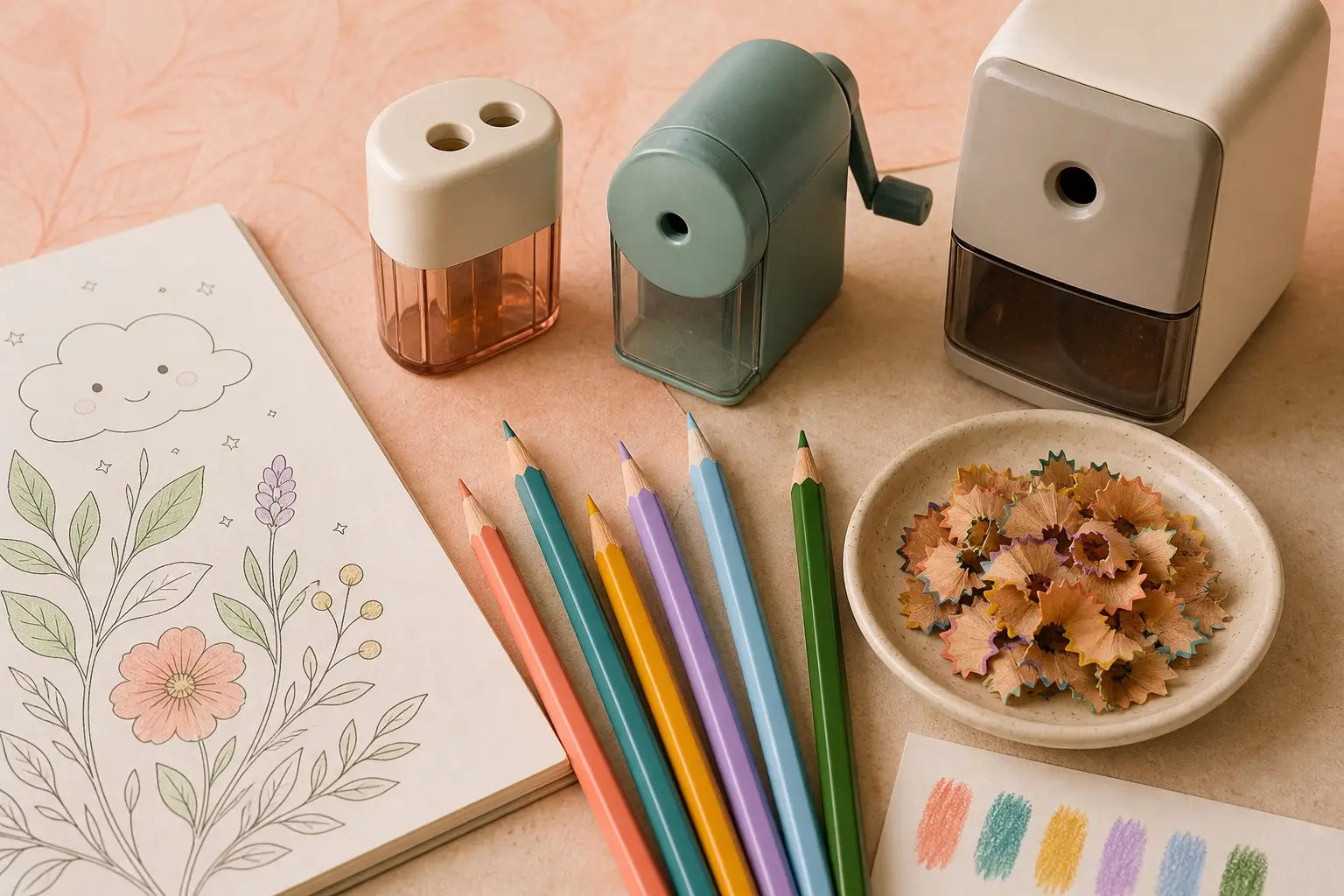
Choose by use case
If you wantStandard soft-core colored pencils that need a choice between a supported coverage point and a finer detail point

Prismacolor Premier Pencil Sharpener
Best overallResearch-based reviewTwo premium-steel blades create either a fine point for small details or a wider point for broader coloring
If you wantColorists who keep standard colored pencils, graphite pencils and jumbo barrels in the same case

Faber-Castell Grip Trio Pencil Sharpener
Best for mixed pencil sizesResearch-based reviewA three-in-one enclosed sharpener with dedicated paths for standard, colored and jumbo pencils
If you wantColorists who want to shorten or lengthen the point without moving to a crank or electric machine

Kutsuwa HiLiNE T'GAAL Adjustable Pencil Sharpener
Best adjustable handheldResearch-based reviewA compact clear sharpener with five selectable angles intended for colored pencils and different lead hardnesses
If you wantHome studios that need adjustable point shape, oversize-pencil support and a stop against over-sharpening

Dahle 133 Pencil Sharpener
Best manual crankResearch-based reviewA desk crank with a sharp-to-blunt point dial, automatic cutting system and extra-large opening for artist pencils
If you wantDerwent and other artist pencils in standard or jumbo barrels when clean shavings containment matters

Derwent Twin Hole Pencil Sharpener
Best enclosed dual-size sharpenerResearch-based reviewTwo fixed metal openings handle 8.25 mm and 11.5 mm pencils inside a clear shavings reservoir
If you wantColorists who want documented standard and thick-pencil angles in a compact, durable tool

STAEDTLER Metal Double-Hole Pencil Sharpener
Best simple metal sharpenerResearch-based reviewAn open metal sharpener with a 23-degree standard hole and a 30-degree hole for thick colored pencils
If you wantHigh-volume studios that sharpen many colored pencils and want adjustable powered output across 6–12 mm barrels

AFMAT PS29 Rechargeable Long Point Pencil Sharpener
Best powered optionResearch-based reviewA rechargeable electric sharpener with automatic stop and an adjustable 8–17 mm point range
If you wantColorists with firmer cores who deliberately want a curved long point in a compact metal canister

Blackwing One-Step Long Point Sharpener
Best premium portable long pointResearch-based reviewA one-step machined-aluminum sharpener that creates a curved long point with a replaceable German steel blade
If you wantDetail colorists who want to shape wood and core separately on firm wood-cased pencils

KUM AS2M Automatic Long Point Sharpener
Best two-step long pointResearch-based reviewA two-stage manual sharpener that removes wood first, then shapes the exposed core, with stops and spare blades
If you wantFirm artist pencils that need repeatable extra-long points for tiny details at a fixed desk

Derwent Super Point Manual Helical Pencil Sharpener
Best studio long-point crankResearch-based reviewA clamped manual crank with a steel helical cutter, auto stop and an extra-long point for pencils up to 8 mm
Product comparison
| Product | Best for | Watch out | Price & shop |
|---|---|---|---|
| Prismacolor Premier Pencil Sharpener (opens Amazon in a new tab) Best overallResearch-based review | Standard soft-core colored pencils that need a choice between a supported coverage point and a finer detail point | It is optimized for conventional Prismacolor barrels and offers only two fixed point profiles, not jumbo compatibility or a multi-position dial | Budget-friendlyCheck price on Amazon (opens Amazon in a new tab) |
| Faber-Castell Grip Trio Pencil Sharpener (opens Amazon in a new tab) Best for mixed pencil sizesResearch-based review | Colorists who keep standard colored pencils, graphite pencils and jumbo barrels in the same case | The three openings prioritize barrel compatibility, not precise angle adjustment or an automatic stop | Budget-friendlyCheck price on Amazon (opens Amazon in a new tab) |
| Kutsuwa HiLiNE T'GAAL Adjustable Pencil Sharpener (opens Amazon in a new tab) Best adjustable handheldResearch-based review | Colorists who want to shorten or lengthen the point without moving to a crank or electric machine | The small reservoir fills quickly, and five settings add a learning step that a fixed two-hole sharpener avoids | Budget-friendlyCheck price on Amazon (opens Amazon in a new tab) |
| Dahle 133 Pencil Sharpener (opens Amazon in a new tab) Best manual crankResearch-based review | Home studios that need adjustable point shape, oversize-pencil support and a stop against over-sharpening | It takes desk space, costs more than handheld sharpeners and still cannot prevent breakage caused by an already fractured core | |
| Derwent Twin Hole Pencil Sharpener (opens Amazon in a new tab) Best enclosed dual-size sharpenerResearch-based review | Derwent and other artist pencils in standard or jumbo barrels when clean shavings containment matters | Derwent excludes charcoal and pastel pencils, and neither opening offers a selectable point angle | Budget-friendlyCheck price on Amazon (opens Amazon in a new tab) |
| STAEDTLER Metal Double-Hole Pencil Sharpener (opens Amazon in a new tab) Best simple metal sharpenerResearch-based review | Colorists who want documented standard and thick-pencil angles in a compact, durable tool | There is no reservoir, stop mechanism or replacement blade in the listed package, so it is messier and more disposable than some alternatives | Budget-friendlyCheck price on Amazon (opens Amazon in a new tab) |
| AFMAT PS29 Rechargeable Long Point Pencil Sharpener (opens Amazon in a new tab) Best powered optionResearch-based review | High-volume studios that sharpen many colored pencils and want adjustable powered output across 6–12 mm barrels | Even its shortest documented setting is a long-point format, and powered sharpening gives less tactile feedback than a careful handheld blade | |
| Blackwing One-Step Long Point Sharpener (opens Amazon in a new tab) Best premium portable long pointResearch-based review | Colorists with firmer cores who deliberately want a curved long point in a compact metal canister | It is expensive for one fixed geometry, holds only about three fresh sharpenings and exposes more core than our default soft-pencil picks | |
| KUM AS2M Automatic Long Point Sharpener (opens Amazon in a new tab) Best two-step long pointResearch-based review | Detail colorists who want to shape wood and core separately on firm wood-cased pencils | The design is officially aimed at precision graphite work, and the second stage can create more exposed pigment than a soft colored pencil needs | Budget-friendlyCheck price on Amazon (opens Amazon in a new tab) |
| Derwent Super Point Manual Helical Pencil Sharpener (opens Amazon in a new tab) Best studio long-point crankResearch-based review | Firm artist pencils that need repeatable extra-long points for tiny details at a fixed desk | It produces one aggressive extra-long point, costs more than handheld options and does not accept pencils wider than 8 mm |
How we researched this guide
- Product listings checked
- Hands-on testing
- None of the 10 picks — all are research-based
- Labels explained
- How we test and label products
This is a research-based buying guide, not a hands-on breakage test. On September 1, 2026, we opened every exact Amazon.com detail page, confirmed a current new offer or active buy box, checked the ASIN and matched the selected variant to its high-resolution Amazon CDN image. We then cross-checked point options, pencil-diameter limits, blade or cutter design, automatic-stop behavior, shavings containment and replacement parts against current manufacturer documentation from Prismacolor, Faber-Castell, Kutsuwa, Dahle, Derwent, STAEDTLER, KUM, AFMAT and Blackwing. We favored sharpeners that let a colorist choose a more supported point, avoid forcing a jumbo barrel, stop wasting wood or separate everyday sharpening from specialist long-point work. We did not measure core-breakage rates, blade life, point angles beyond documented specifications, sharpening speed, motor torque, noise, pencil consumption or compatibility with every colored-pencil brand. Availability and packaging can change, so recheck the linked detail page before buying.
Testing status by pick
- Prismacolor Premier Pencil SharpenerResearch-based review
- Faber-Castell Grip Trio Pencil SharpenerResearch-based review
- Kutsuwa HiLiNE T'GAAL Adjustable Pencil SharpenerResearch-based review
- Dahle 133 Pencil SharpenerResearch-based review
- Derwent Twin Hole Pencil SharpenerResearch-based review
- STAEDTLER Metal Double-Hole Pencil SharpenerResearch-based review
- AFMAT PS29 Rechargeable Long Point Pencil SharpenerResearch-based review
- Blackwing One-Step Long Point SharpenerResearch-based review
- KUM AS2M Automatic Long Point SharpenerResearch-based review
- Derwent Super Point Manual Helical Pencil SharpenerResearch-based review
Product details and drawbacks
Prismacolor Premier Pencil Sharpener (opens Amazon in a new tab)
Two premium-steel blades create either a fine point for small details or a wider point for broader coloring

Why it fits this guide
Prismacolor designed this sharpener specifically for Premier colored pencils, making it the most direct fit for the problem behind this guide. The wider option preserves more support around a soft core for ordinary coverage, while the fine option is available when a small printed space needs precision. The translucent enclosed body also keeps pigment-tinted shavings away from the page.
Honest drawback
It is optimized for conventional Prismacolor barrels and offers only two fixed point profiles, not jumbo compatibility or a multi-position dial
Specifications
- Exact Amazon.com ASIN had an in-stock buy box on September 1, 2026
- Two separate high-quality steel blades for fine and wide or medium points
- Translucent enclosed body shows when the reservoir needs emptying
Best forStandard soft-core colored pencils that need a choice between a supported coverage point and a finer detail point
Pros
- Designed around Prismacolor Premier colored pencils
- Wider point option gives a soft core more support
- Fine point remains available for intricate coloring areas
Cons
- No documented jumbo-pencil opening
- Blades are not listed as user-replaceable
Faber-Castell Grip Trio Pencil Sharpener (opens Amazon in a new tab)
A three-in-one enclosed sharpener with dedicated paths for standard, colored and jumbo pencils

Why it fits this guide
Grip Trio solves a fit problem rather than chasing one extreme point. Faber-Castell documents steel blades for color, watercolor, pastel and graphite pencils plus three barrel sizes, so it is the practical family-table or mixed-media choice. Its large waste box and triangular body are easier to manage than an open metal sharpener near a coloring book.
Honest drawback
The three openings prioritize barrel compatibility, not precise angle adjustment or an automatic stop
Specifications
- Exact grey Amazon.com variant had an in-stock buy box on September 1, 2026
- Three-in-one format for popular standard and jumbo pencil shapes
- Built-in extra-large shavings collector
Best forColorists who keep standard colored pencils, graphite pencils and jumbo barrels in the same case
Pros
- One tool covers several common art-pencil sizes
- Enclosed triangular body is practical on shared tables
- Manufacturer explicitly includes colored pencils
Cons
- Bulkier than a single-hole pocket sharpener
- No selectable point-length dial
Kutsuwa HiLiNE T'GAAL Adjustable Pencil Sharpener (opens Amazon in a new tab)
A compact clear sharpener with five selectable angles intended for colored pencils and different lead hardnesses

Why it fits this guide
T'GAAL gives a colorist the most point control in a pocket-sized manual format. Kutsuwa's current product page says the five positions can be chosen for colored pencils, HB and other core hardnesses. That makes it useful when one set has a soft laydown pencil for coverage and a firmer pencil for details, although the exact best setting still needs to be learned with scrap-paper tests.
Honest drawback
The small reservoir fills quickly, and five settings add a learning step that a fixed two-hole sharpener avoids
Specifications
- Exact clear RS028CL Amazon.com variant had an active new offer on September 1, 2026
- Five selectable sharpening angles
- Steel blade unit in a transparent enclosed body
Best forColorists who want to shorten or lengthen the point without moving to a crank or electric machine
Pros
- Lets one handheld sharpener produce more or less exposed core
- Manufacturer explicitly mentions colored-pencil use
- Compact shavings container suits a pencil case
Cons
- No documented jumbo-barrel opening
- Dial settings require experimentation for each pencil range
Dahle 133 Pencil Sharpener (opens Amazon in a new tab)
A desk crank with a sharp-to-blunt point dial, automatic cutting system and extra-large opening for artist pencils

Why it fits this guide
Dahle 133 is the strongest desk option for soft-core control because its features address both geometry and waste. The dial moves between sharp and blunt results, the handle spins freely when the selected point is complete, and the 11.5 mm capacity accommodates many oversize art pencils. Dahle also documents soft clamping jaws intended to avoid marks on higher-quality pencils.
Honest drawback
It takes desk space, costs more than handheld sharpeners and still cannot prevent breakage caused by an already fractured core
Specifications
- Exact Amazon.com ASIN had an in-stock buy box on September 1, 2026
- Adjustable sharp-to-blunt point with automatic cutting system
- Accepts pencils up to 11.5 mm in diameter
Best forHome studios that need adjustable point shape, oversize-pencil support and a stop against over-sharpening
Pros
- Adjustable point supports both soft coverage pencils and finer tools
- Automatic cut-off helps reduce unnecessary pencil loss
- Oversize capacity covers more artist-pencil barrels
Cons
- Less portable than a handheld sharpener
- Cutter is removable for cleaning but not listed as replaceable
Derwent Twin Hole Pencil Sharpener (opens Amazon in a new tab)
Two fixed metal openings handle 8.25 mm and 11.5 mm pencils inside a clear shavings reservoir

Why it fits this guide
Derwent Twin Hole is the uncomplicated choice between a brand-specific soft-core sharpener and an adjustable crank. Its two documented diameters fit most Derwent and many other artist pencils, and the tub keeps debris contained. The larger hole is useful for jumbo colored pencils without asking a colorist to buy a desk machine.
Honest drawback
Derwent excludes charcoal and pastel pencils, and neither opening offers a selectable point angle
Specifications
- Exact black Amazon.com variant had an in-stock buy box on September 1, 2026
- Metal twin-hole sharpener with 8.25 mm and 11.5 mm openings
- Plastic reservoir collects shavings
Best forDerwent and other artist pencils in standard or jumbo barrels when clean shavings containment matters
Pros
- Covers standard and jumbo artist pencils
- Enclosed tub is easy to use beside paper
- Simple manual design has no charging or desk clamp
Cons
- Fixed point profiles only
- Not compatible with Derwent Charcoal or Pastel pencils
STAEDTLER Metal Double-Hole Pencil Sharpener (opens Amazon in a new tab)
An open metal sharpener with a 23-degree standard hole and a 30-degree hole for thick colored pencils

Why it fits this guide
STAEDTLER publishes unusually clear geometry: the 8.2 mm opening uses a 23-degree angle for accurate lines, while the 10.2 mm opening uses a 30-degree angle for broader, softer lines. The latter is the more conservative starting point for a thick soft-core pencil. The all-metal body is compact, inexpensive and easy to dedicate to colored pencils.
Honest drawback
There is no reservoir, stop mechanism or replacement blade in the listed package, so it is messier and more disposable than some alternatives
Specifications
- Exact Amazon.com ASIN had an in-stock buy box on September 1, 2026
- 23-degree opening for standard pencils up to 8.2 mm
- 30-degree opening for thick graphite and colored pencils up to 10.2 mm
Best forColorists who want documented standard and thick-pencil angles in a compact, durable tool
Pros
- Manufacturer documents both angles and diameter limits
- Thick-pencil opening favors a broad supported point
- Very compact all-metal construction
Cons
- Open design drops shavings unless used over a container
- No automatic stop or point dial
AFMAT PS29 Rechargeable Long Point Pencil Sharpener (opens Amazon in a new tab)
A rechargeable electric sharpener with automatic stop and an adjustable 8–17 mm point range

Why it fits this guide
AFMAT PS29 is the efficiency pick rather than the default soft-core pick. It accepts a broad range of standard and jumbo colored pencils, stops automatically and lets the user reduce the point from the 17 mm maximum. That adjustability is essential here: choose the shorter end for vulnerable soft cores and reserve the dramatic long point for firm pencils that can support it.
Honest drawback
Even its shortest documented setting is a long-point format, and powered sharpening gives less tactile feedback than a careful handheld blade
Specifications
- Exact Amazon.com ASIN had an in-stock buy box on September 1, 2026
- Rechargeable electric operation with automatic stop
- Adjustable 8–17 mm point for pencils about 6–12 mm in diameter
Best forHigh-volume studios that sharpen many colored pencils and want adjustable powered output across 6–12 mm barrels
Pros
- Faster workflow for a large coloring-pencil collection
- Broad barrel-size compatibility
- Adjustable length and auto stop reduce unnecessary sharpening
Cons
- Long-point geometry is not ideal for every soft core
- Bulkier and more expensive than manual picks
Blackwing One-Step Long Point Sharpener (opens Amazon in a new tab)
A one-step machined-aluminum sharpener that creates a curved long point with a replaceable German steel blade

Why it fits this guide
Blackwing is the specialist pocket choice for a colorist who values point length and build quality. The brand says its curved geometry resists breakage, and Amazon lists colored-pencil use, while replacement blades make the body maintainable. We would still reserve it for firmer cores or controlled detail work rather than assume every buttery pencil benefits from maximum exposure.
Honest drawback
It is expensive for one fixed geometry, holds only about three fresh sharpenings and exposes more core than our default soft-pencil picks
Specifications
- Exact black Amazon.com variant had an in-stock buy box on September 1, 2026
- Machined aluminum body with German steel blade
- Curved long point and a canister sized for about three fresh sharpenings
Best forColorists with firmer cores who deliberately want a curved long point in a compact metal canister
Pros
- Replaceable blade extends the useful life of the body
- Enclosed premium construction suits a travel kit
- Curved point gives more usable side area for firm pencils
Cons
- Premium cost and small shavings capacity
- Fixed long point is not conservative for fragile cores
KUM AS2M Automatic Long Point Sharpener (opens Amazon in a new tab)
A two-stage manual sharpener that removes wood first, then shapes the exposed core, with stops and spare blades

Why it fits this guide
KUM AS2M offers more deliberate control than a one-hole long-point sharpener. The first opening stops after exposing the core; the second sharpens that core to its final point. Two included spare blades improve maintainability. For colored pencils, the benefit is precision, not universal protection, so test a firm pencil first and stop after stage one if a blunt exposed core already suits the technique.
Honest drawback
The design is officially aimed at precision graphite work, and the second stage can create more exposed pigment than a soft colored pencil needs
Specifications
- Exact blue Amazon.com variant had an in-stock buy box on September 1, 2026
- Separate wood and lead sharpening stages with automatic stops
- Includes two spare blades plus 2 mm and 3.15 or 3.2 mm lead pointers
Best forDetail colorists who want to shape wood and core separately on firm wood-cased pencils
Pros
- Separate stages make point shaping intentional
- Automatic stops reduce needless removal in each stage
- Spare blades are included
Cons
- Two steps are slower than ordinary sharpening
- Extra-long point is best reserved for firmer cores
Derwent Super Point Manual Helical Pencil Sharpener (opens Amazon in a new tab)
A clamped manual crank with a steel helical cutter, auto stop and an extra-long point for pencils up to 8 mm

Why it fits this guide
Derwent Super Point is the long-point studio counterpart to the Dahle. Its self-feeding helical cutter and auto stop are useful when a colorist prepares many firm pencils for fine lines, and the sliding reservoir contains the waste. It ranks lower for soft cores because the geometry is fixed at an extra-long point and the 8 mm limit excludes jumbo pencils.
Honest drawback
It produces one aggressive extra-long point, costs more than handheld options and does not accept pencils wider than 8 mm
Specifications
- Exact Amazon.com ASIN had an in-stock buy box on September 1, 2026
- High-performance steel helical cutter with auto stop
- Sharpens pencils up to 8 mm to an extra-long point
Best forFirm artist pencils that need repeatable extra-long points for tiny details at a fixed desk
Pros
- Repeatable crank workflow for multiple firm pencils
- Auto stop and enclosed reservoir reduce waste and mess
- Desk clamp stabilizes the sharpener
Cons
- Fixed extra-long point is not the safest default for soft cores
- Does not fit jumbo pencils over 8 mm
Corrections
Spotted an error or outdated detail? Read how we handle corrections.
Related guides
Best Colored Pencils for Adult Coloring Books
Compare 10 colored-pencil sets for adult coloring books by core feel, color range, detail control, layering, paper fit, storage and replacement options.

Best Pencil Sharpeners for Artists
Compare the best pencil sharpeners for artists, including long-point, crank, adjustable and electric picks for graphite, charcoal and drawing pencils.
Best Watercolor Pencils for Coloring Books
Compare 10 beginner-friendly watercolor-pencil sets for coloring books by dry control, water activation, palette size, paper fit, core feel and storage.
Best Colored Pencil Blenders and Burnishers for Smoother Shading
Compare 8 colorless blender pencils, burnishers, pens and liquids for smoother colored-pencil gradients, softer edges and polished final layers.


