
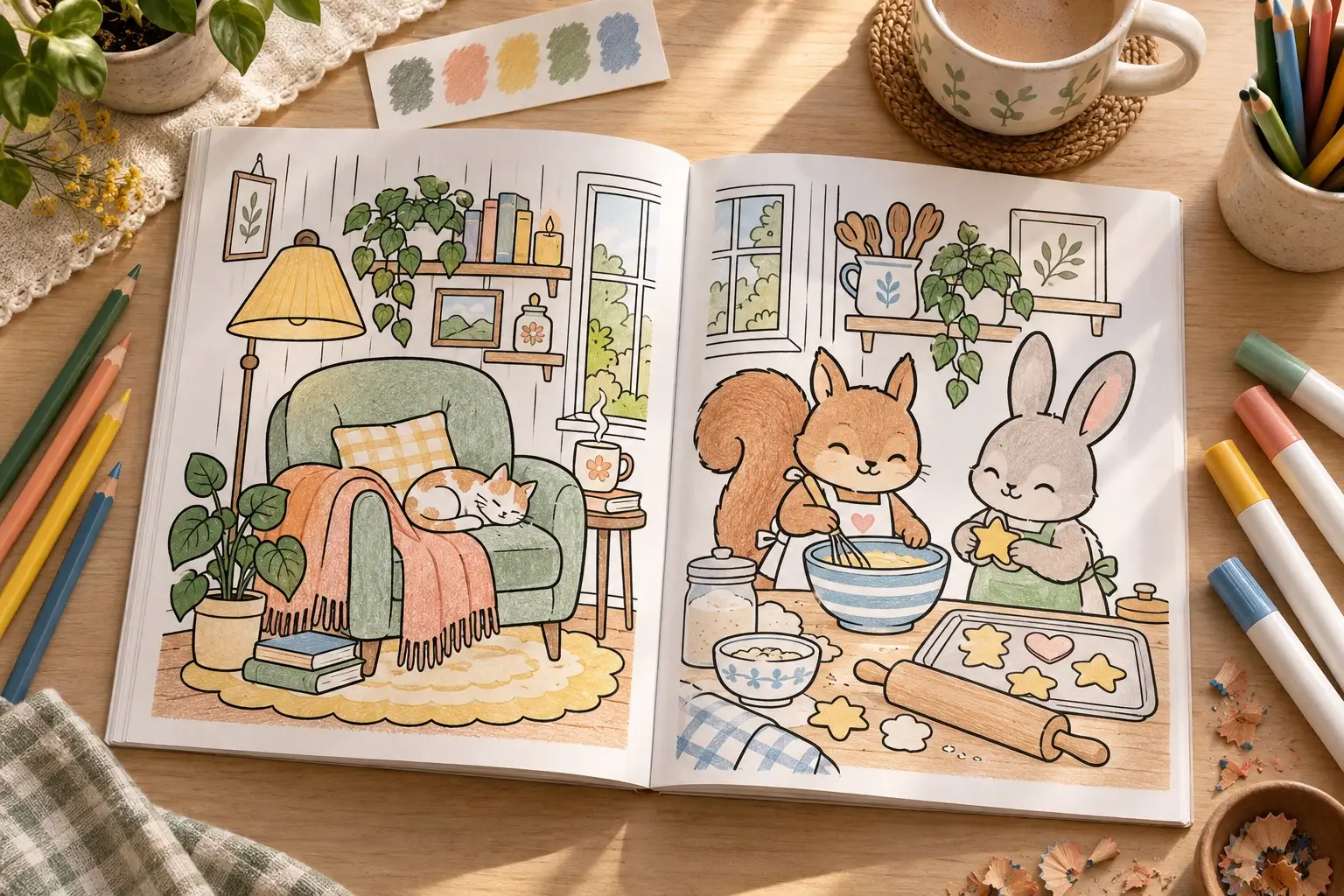
Choose by use case
If you wantColorists who want to decorate inviting rooms, kitchens and shopfronts

Coco Wyo Little Corner Coloring Book
Best overall cozy pickResearch-based reviewForty hand-drawn single-sided square scenes use large, bold forms to turn compact interiors into approachable coloring projects
If you wantBuyers who want many subjects and quick designs in one book

Jade Summer 100 Bold Coloring Book
Best varietyResearch-based reviewOne hundred bold images cover animals, flowers, food, people, objects, fantasy subjects and mandalas, including eighty full-page designs
If you wantAnimal lovers who want friendship stories and familiar everyday activities

Coco Wyo Cozy Friends Coloring Book
Best animal scenesResearch-based reviewForty single-sided square pages show cute animal friends cooking, cleaning and sharing other simple moments in bold line art
If you wantTeens and adults who prefer reading, tea, quiet mornings and other familiar routines

Coco Wyo Girl Moments Coloring Book
Best everyday-life themeResearch-based reviewForty single-sided square designs center calm daily activities in a cohesive cute and cozy style
If you wantColorists who want ghosts, odd creatures and Halloween-adjacent hygge scenes without graphic horror

Coco Wyo Spooky Cutie Coloring Book
Best spooky-cute pickResearch-based reviewForty hand-drawn single-sided pages combine cute-creepy characters with cozy square compositions
If you wantBuyers who want forty-five large bold interiors in a compact Random House paperback

Coco Wyo Cozy Corner Coloring Book
Best publisher editionResearch-based reviewForty-five hand-drawn reading-nook, bakery and kitchen scenes use an 8-inch-square publisher format with large easy-to-color shapes
Product comparison
| Product | Best for | Watch out | Price & shop |
|---|---|---|---|
| Coco Wyo Little Corner Coloring Book (opens Amazon in a new tab) Best overall cozy pickResearch-based review | Colorists who want to decorate inviting rooms, kitchens and shopfronts | Full-room scenes contain repeated walls, floors, furniture and small decor, so they can take longer and require more palette planning than one-object bold pages | Budget-friendlyCheck price on Amazon (opens Amazon in a new tab) |
| Jade Summer 100 Bold Coloring Book (opens Amazon in a new tab) Best varietyResearch-based review | Buyers who want many subjects and quick designs in one book | Twenty designs are quarter-page compositions, the themes can feel less cohesive than a dedicated cozy series, and the exact paper weight is not published | Budget-friendlyCheck price on Amazon (opens Amazon in a new tab) |
| Coco Wyo Cozy Friends Coloring Book (opens Amazon in a new tab) Best animal scenesResearch-based review | Animal lovers who want friendship stories and familiar everyday activities | Household backgrounds add some smaller objects, and the nonperforated paperback needs a barrier sheet whenever marker ink could reach the page beneath | Budget-friendlyCheck price on Amazon (opens Amazon in a new tab) |
| Coco Wyo Girl Moments Coloring Book (opens Amazon in a new tab) Best everyday-life themeResearch-based review | Teens and adults who prefer reading, tea, quiet mornings and other familiar routines | The human-centered self-care theme will not suit buyers who prefer animals or object-only art, and the exact product page does not publish a paper-weight figure | Budget-friendlyCheck price on Amazon (opens Amazon in a new tab) |
| Coco Wyo Spooky Cutie Coloring Book (opens Amazon in a new tab) Best spooky-cute pickResearch-based review | Colorists who want ghosts, odd creatures and Halloween-adjacent hygge scenes without graphic horror | Cute-creepy subject matter can feel seasonal, and the approximately 80–90 gsm glue-bound pages tolerate less liquid or heavy handling than a dedicated marker pad | Budget-friendlyCheck price on Amazon (opens Amazon in a new tab) |
| Coco Wyo Cozy Corner Coloring Book (opens Amazon in a new tab) Best publisher editionResearch-based review | Buyers who want forty-five large bold interiors in a compact Random House paperback | Its subject overlaps Little Corner, and neither Penguin Random House nor the exact Amazon detail page publishes a paper-weight specification or offers perforated pages | Budget-friendlyCheck price on Amazon (opens Amazon in a new tab) |
How we researched this guide
- Product listings checked
- Hands-on testing
- None of the 6 picks — all are research-based
- Labels explained
- How we test and label products
This is a research-based buying guide, not a hands-on coloring or paper test. On September 22, 2026, we opened each exact Amazon.com detail page in a US delivery context, confirmed the ASIN, an in-stock purchase path and the listing's matching direct Amazon CDN image. We cross-checked design counts, page layout, trim size, binding, intended audience and paper disclosures against current Coco Wyo, Jade Summer and Penguin Random House pages. We rejected a Coco Wyo Stress Relief candidate because its own exact detail page said it was currently unavailable. KawaiiToons has not colored in these copies or measured paper weight, marker bleed, show-through, line thickness, print quality or binding durability. Recommendations therefore reflect documented formats and useful differences, not invented performance scores.
Testing status by pick
- Coco Wyo Little Corner Coloring BookResearch-based review
- Jade Summer 100 Bold Coloring BookResearch-based review
- Coco Wyo Cozy Friends Coloring BookResearch-based review
- Coco Wyo Girl Moments Coloring BookResearch-based review
- Coco Wyo Spooky Cutie Coloring BookResearch-based review
- Coco Wyo Cozy Corner Coloring BookResearch-based review
Product details and drawbacks
Coco Wyo Little Corner Coloring Book (opens Amazon in a new tab)
Forty hand-drawn single-sided square scenes use large, bold forms to turn compact interiors into approachable coloring projects

Why it fits this guide
Little Corner captures the core appeal of the category without reducing every page to an isolated object. Coco Wyo documents forty hand-drawn 8.5-inch-square illustrations of spaces such as a kitchen, bedroom, fireplace and shopfront. Large furniture, windows, shelves and plants provide obvious color zones, while smaller cushions and decor leave room for accents. The single-sided format protects reverse artwork, although Coco Wyo's approximately 80–90 gsm Amazon paper still needs a clean backing sheet with markers. Choose it for the decorating theme, not for a claim that the paper is heavy or bleed-proof.
Honest drawback
Full-room scenes contain repeated walls, floors, furniture and small decor, so they can take longer and require more palette planning than one-object bold pages
Specifications
- Exact Amazon ASIN B0D5HVSW5T was in stock with a purchase path on September 22, 2026
- Forty hand-drawn single-sided designs in an 8.5 by 8.5 inch format
- Coco Wyo identifies its Amazon-printed paperback paper as approximately 80–90 gsm
Best forColorists who want to decorate inviting rooms, kitchens and shopfronts
Pros
- Cohesive interiors make it satisfying to plan room palettes
- Large shapes balance easy coloring with enough environmental detail
- Single-sided pages keep each illustration on its own sheet
Cons
- Backgrounds can take longer than isolated motifs
- Glue-bound pages are not perforated
Jade Summer 100 Bold Coloring Book (opens Amazon in a new tab)
One hundred bold images cover animals, flowers, food, people, objects, fantasy subjects and mandalas, including eighty full-page designs

Why it fits this guide
Jade Summer's book is the practical alternative to a tightly themed cozy collection. The publisher documents one hundred unique human-drawn images: eighty full-page compositions and twenty quarter-page designs. Subjects range from food and flowers to animals, people, objects, fantasy scenes and mandalas. Bold lines and the absence of intricate details lower the precision burden, while the broad mix makes it easy to select a page for a short session. The trade-off is cohesion—this is a large assortment rather than one continuous cozy world.
Honest drawback
Twenty designs are quarter-page compositions, the themes can feel less cohesive than a dedicated cozy series, and the exact paper weight is not published
Specifications
- Exact Amazon ASIN 1961737183 was in stock with add-to-cart and buy-now controls on September 22, 2026
- One hundred unique images comprise eighty full-page and twenty quarter-page designs
- Jade Summer documents single-sided white-backed pages, bold lines and no intricate details
Best forBuyers who want many subjects and quick designs in one book
Pros
- Highest documented image count here
- Wide subject mix reduces the risk of theme fatigue
- Large-print line work suits beginners and broad marker tips
Cons
- Twenty images are not full-page
- Paper weight is not documented
Coco Wyo Cozy Friends Coloring Book (opens Amazon in a new tab)
Forty single-sided square pages show cute animal friends cooking, cleaning and sharing other simple moments in bold line art

Why it fits this guide
Cozy Friends uses characters to create a small story on every page. Coco Wyo describes forty hand-drawn 8.5-inch-square designs centered on animal friends doing familiar activities such as cooking, laundry and cleaning. Faces and larger body shapes provide easy focal areas, while household props add just enough variety for a coordinated palette. It is more narrative than the mixed Jade Summer book and less architecture- focused than Little Corner. The Amazon paperback is still a glue-bound, approximately 80–90 gsm format, not an artist-paper pad.
Honest drawback
Household backgrounds add some smaller objects, and the nonperforated paperback needs a barrier sheet whenever marker ink could reach the page beneath
Specifications
- Exact Amazon ASIN B0D4YLQRMP was in stock with a purchase path on September 22, 2026
- Forty hand-drawn single-sided pages in an 8.5 by 8.5 inch format
- Coco Wyo documents large, bold and easy artwork built around everyday animal activities
Best forAnimal lovers who want friendship stories and familiar everyday activities
Pros
- Friendly character stories give each page a clear mood
- Bold animal forms suit flat fills and simple shading
- Forty designs stay varied within one coherent theme
Cons
- Some household props are smaller than the central characters
- Pages are neither perforated nor marker-proof
Coco Wyo Girl Moments Coloring Book (opens Amazon in a new tab)
Forty single-sided square designs center calm daily activities in a cohesive cute and cozy style

Why it fits this guide
Girl Moments replaces animals and imaginary rooms with recognizable daily routines. Coco Wyo documents forty hand-drawn, single-sided pages featuring moments such as a quiet morning, a warm drink or time spent reading. Clothing, mugs, blankets and room accents make the theme useful for practicing limited palettes without the complexity of realistic portrait coloring. It is the most human-centered choice here, which is exactly why it can feel personal to one buyer and too narrow to another.
Honest drawback
The human-centered self-care theme will not suit buyers who prefer animals or object-only art, and the exact product page does not publish a paper-weight figure
Specifications
- Exact Amazon ASIN B0DL5SF36B was in stock with a purchase path on September 22, 2026
- Forty hand-drawn single-sided illustrations in an 8.5 by 8.5 inch format
- Coco Wyo centers the collection on cozy, familiar daily activities
Best forTeens and adults who prefer reading, tea, quiet mornings and other familiar routines
Pros
- Relatable scenes make palette ideas easy to imagine
- Square format is compact enough for a lap desk
- Cohesive subject makes it a clear gift for the right person
Cons
- Narrower appeal than mixed motifs or animal pages
- Exact paper weight for this edition is not stated
Coco Wyo Spooky Cutie Coloring Book (opens Amazon in a new tab)
Forty hand-drawn single-sided pages combine cute-creepy characters with cozy square compositions

Why it fits this guide
Spooky Cutie keeps the bold cozy format but changes the emotional tone. Coco Wyo documents forty hand-drawn single-sided 8.5-inch-square designs filled with peculiar, mystical and adorable creatures. Large forms leave room for simple gradients, while pumpkins, windows, blankets and small fantasy props support richer seasonal palettes. The publisher also openly describes the Amazon paper as approximately 80–90 gsm, so a protective sheet remains necessary with markers. It is playful rather than graphic, but the theme is still specific.
Honest drawback
Cute-creepy subject matter can feel seasonal, and the approximately 80–90 gsm glue-bound pages tolerate less liquid or heavy handling than a dedicated marker pad
Specifications
- Exact Amazon ASIN B0D943SQXV was in stock with a purchase path on September 22, 2026
- Forty hand-drawn single-sided designs in an 8.5 by 8.5 inch format
- Coco Wyo states that the Amazon paperback uses approximately 80–90 gsm paper
Best forColorists who want ghosts, odd creatures and Halloween-adjacent hygge scenes without graphic horror
Pros
- Distinct cute-creepy theme stands apart from generic cozy rooms
- Bold characters leave room for simple shadows and highlights
- Publisher clearly discloses the approximate paper weight
Cons
- Theme is less universal than animals or mixed motifs
- Light paper requires a marker barrier
Coco Wyo Cozy Corner Coloring Book (opens Amazon in a new tab)
Forty-five hand-drawn reading-nook, bakery and kitchen scenes use an 8-inch-square publisher format with large easy-to-color shapes

Why it fits this guide
Cozy Corner is the publisher-edition alternative to Coco Wyo's Amazon- printed square books. Penguin Random House documents forty-five hand- drawn pages, an 8-by-8-inch trim and large bold designs focused on reading alcoves, bakeries, kitchens and other comforting spaces. The extra five designs and slightly smaller trim are real differences, not a promise of superior paper performance. It overlaps Little Corner more than any other pair here, so buyers should compare interior subjects and the exact edition instead of ordering both by title alone.
Honest drawback
Its subject overlaps Little Corner, and neither Penguin Random House nor the exact Amazon detail page publishes a paper-weight specification or offers perforated pages
Specifications
- Exact Amazon ASIN B0DSDN3M6D was in stock with a purchase path on September 22, 2026
- Penguin Random House documents forty-five hand-drawn designs and an 8 by 8 inch trim
- The publisher lists large, bold artwork and an age range of seven and up
Best forBuyers who want forty-five large bold interiors in a compact Random House paperback
Pros
- Forty-five documented pages exceed most Coco Wyo picks here
- Compact publisher format is easy to support on a small desk
- Interiors include reading, baking and kitchen subjects
Cons
- Significant thematic overlap with Little Corner
- Exact paper weight is not published
Corrections
Spotted an error or outdated detail? Read how we handle corrections.
Related guides
Best Adult Coloring Books for Beginners
Five research-based adult coloring books for beginners, compared by artwork density, page format, paper details, portability and theme.
Best Color-by-Number Books for Adults
Seven research-based adult color-by-number books compared by detail, theme, page format, binding, color keys and fit for pencils or markers.
Best Coloring Books for Alcohol Markers
Six research-based coloring books for alcohol markers, compared by single-sided layout, documented paper stock, perforations, binding and artwork detail.
Best Coloring Books for Colored Pencils
Six research-based coloring books for colored pencils, compared by paper tooth, page format, binding, artwork detail and room for layered shading.


