
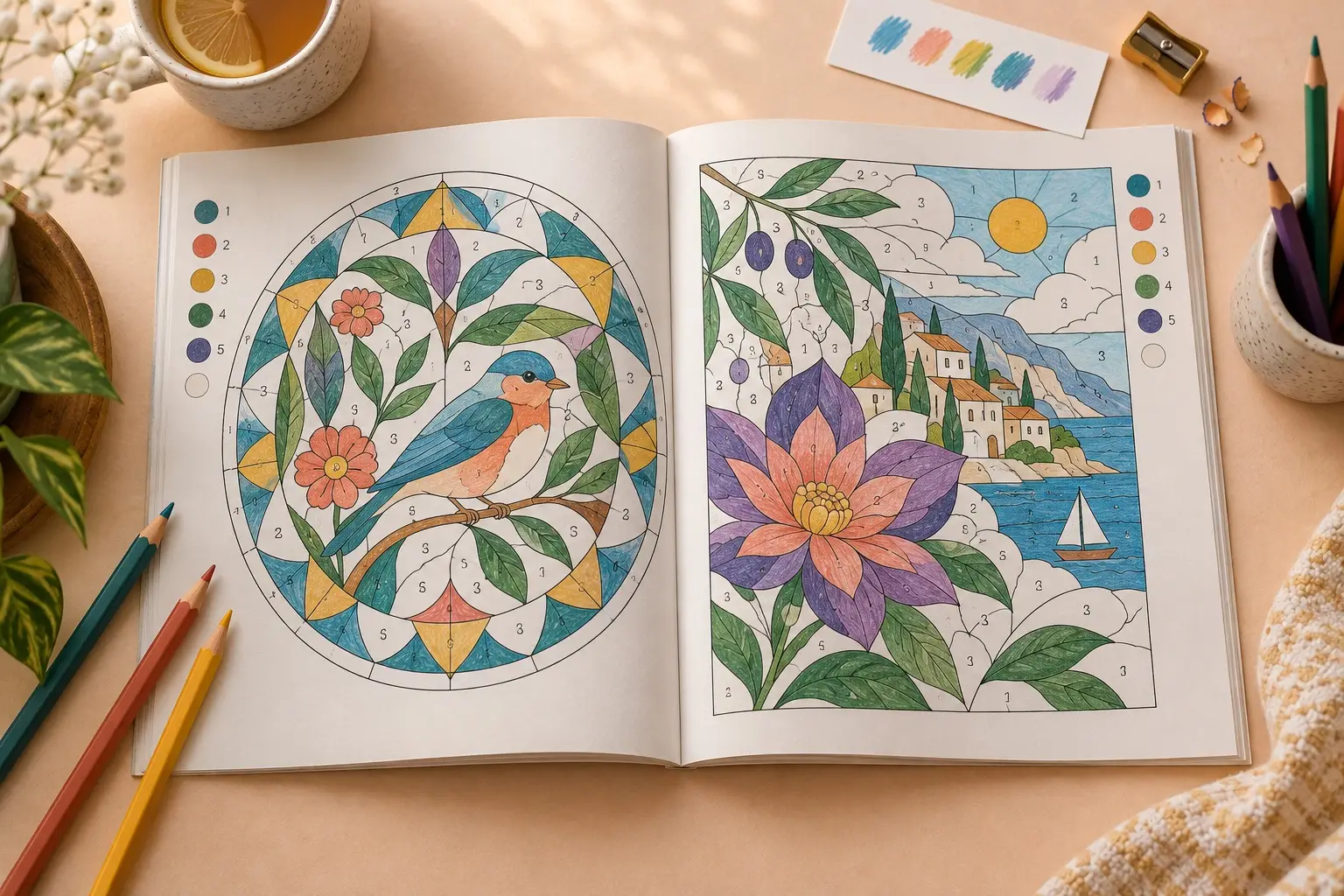
Choose by use case
If you wantBeginners who want large-print patterns, a key under every image and a spiral binding

Brain Games Color by Number Large Print: Patterns
Easiest overallResearch-based reviewTwenty-seven floral and geometric pictures pair numbered cells with page-level swatches, one-sided perforated paper and a full-color answer section
If you wantAdults who want intricate facets, saturated jewel colors and a current subject

Creative Haven Gemstones Color by Number
Best detailed pickResearch-based reviewForty-six gemstone illustrations turn facets, reflections and settings into detailed numbered projects with a simple palette key
If you wantColorists who want animals, plants, gardens, mountains and lakes rather than one narrow subject

Creative Haven Wonders of Nature Color by Number
Best nature varietyResearch-based reviewForty-six detailed outdoor scenes combine flora and fauna with gardens, water and layered landscape backgrounds
If you wantAdults who enjoy identifiable species, realistic plumage and habitat scenes

Creative Haven Birds Color by Number Coloring Book
Best for bird loversResearch-based reviewForty-six identified birds range from spoonbills and flamingos to wild turkeys, cedar waxwings and Baltimore orioles
If you wantColorists who prefer symmetry, repetition and predictable circular progress

Creative Haven Mandalas Color by Number Coloring Book
Best for patternsResearch-based reviewForty-six numbered mandalas turn complex repeating shapes into guided palettes while leaving room to substitute personal colors
If you wantAdults who want cities, islands, markets and mountain scenery in one collection

Creative Haven Around the World Color by Number
Best world travelResearch-based reviewForty-six travel scenes move among major cities, tropical islands, mountaintop views, markets and other destinations
If you wantRoad-trip fans who want American landmarks and off-the-beaten-track scenery

Creative Haven Road Trip USA Color by Number
Best U.S. travel themeResearch-based reviewForty-six scenes travel from Maine to California through familiar landmarks and less-obvious American destinations
Product comparison
| Product | Best for | Watch out | Price & shop |
|---|---|---|---|
| Brain Games Color by Number Large Print: Patterns (opens Amazon in a new tab) Easiest overallResearch-based review | Beginners who want large-print patterns, a key under every image and a spiral binding | Twenty-seven projects is the smallest selection here, and printed numerals plus cell boundaries can still feel visually busy | Budget-friendlyCheck price on Amazon (opens Amazon in a new tab) |
| Creative Haven Gemstones Color by Number (opens Amazon in a new tab) Best detailed pickResearch-based review | Adults who want intricate facets, saturated jewel colors and a current subject | Small facets and repeating highlights demand careful number tracking, and no exact paper-weight figure is published | Budget-friendlyCheck price on Amazon (opens Amazon in a new tab) |
| Creative Haven Wonders of Nature Color by Number (opens Amazon in a new tab) Best nature varietyResearch-based review | Colorists who want animals, plants, gardens, mountains and lakes rather than one narrow subject | Layered backgrounds make completion slower, and the publisher does not disclose exact paper weight or a minimum numeral size | Budget-friendlyCheck price on Amazon (opens Amazon in a new tab) |
| Creative Haven Birds Color by Number Coloring Book (opens Amazon in a new tab) Best for bird loversResearch-based review | Adults who enjoy identifiable species, realistic plumage and habitat scenes | Feather and habitat detail requires a sharp point and close number reading, while exact paper weight is not disclosed | Budget-friendlyCheck price on Amazon (opens Amazon in a new tab) |
| Creative Haven Mandalas Color by Number Coloring Book (opens Amazon in a new tab) Best for patternsResearch-based review | Colorists who prefer symmetry, repetition and predictable circular progress | The subject mix is deliberately repetitive, and narrow symmetric sections are awkward for broad tips | Budget-friendlyCheck price on Amazon (opens Amazon in a new tab) |
| Creative Haven Around the World Color by Number (opens Amazon in a new tab) Best world travelResearch-based review | Adults who want cities, islands, markets and mountain scenery in one collection | Architecture and scenery can create small irregular cells, and the broad itinerary cannot explore one place deeply | Budget-friendlyCheck price on Amazon (opens Amazon in a new tab) |
| Creative Haven Road Trip USA Color by Number (opens Amazon in a new tab) Best U.S. travel themeResearch-based review | Road-trip fans who want American landmarks and off-the-beaten-track scenery | Cars, buildings and layered landscapes require more precise coloring than broad patterns, and the theme is geographically specific | Budget-friendlyCheck price on Amazon (opens Amazon in a new tab) |
How we researched this guide
- Product listings checked
- Hands-on testing
- None of the 7 picks — all are research-based
- Labels explained
- How we test and label products
This is a research-based buying guide, not a hands-on paper, print or coloring test. On September 26, 2026, we opened each exact Amazon.com detail page in a US delivery context, confirmed the ISBN-derived ASIN, an in-stock offer sold by Amazon.com with add-to-cart and buy-now controls, and the matching direct Amazon CDN cover image. We cross-checked image counts, themes, color-key design, page construction, binding and trim details against current Publications International/Brain Games and Dover Publications pages and catalogs. KawaiiToons has not colored in these copies or measured paper weight, numeral size, cell dimensions, print contrast, marker bleed, show-through, binding durability or perforation strength. Rankings reflect documented formats and meaningful creative differences, not customer ratings, temporary prices or wellness claims.
Testing status by pick
- Brain Games Color by Number Large Print: PatternsResearch-based review
- Creative Haven Gemstones Color by NumberResearch-based review
- Creative Haven Wonders of Nature Color by NumberResearch-based review
- Creative Haven Birds Color by Number Coloring BookResearch-based review
- Creative Haven Mandalas Color by Number Coloring BookResearch-based review
- Creative Haven Around the World Color by NumberResearch-based review
- Creative Haven Road Trip USA Color by NumberResearch-based review
Product details and drawbacks
Brain Games Color by Number Large Print: Patterns (opens Amazon in a new tab)
Twenty-seven floral and geometric pictures pair numbered cells with page-level swatches, one-sided perforated paper and a full-color answer section

Why it fits this guide
This is the most approachable format in the group. Publications International puts a swatch key beneath each picture, so the colorist does not need to hold a page open while checking a palette elsewhere. The spiral binding keeps the active sheet flat, and perforations allow it to move to a clipboard or lap board. The publisher calls the book large print, but that label does not establish a minimum numeral or cell size, so an interior preview remains important for low-vision use.
Honest drawback
Twenty-seven projects is the smallest selection here, and printed numerals plus cell boundaries can still feel visually busy
Specifications
- Exact Amazon ASIN 1645589579 was in stock, sold by Amazon.com and showed add-to-cart and buy-now controls on September 26, 2026
- Twenty-seven floral and geometric color-by-number images with a swatch palette beneath each image
- Publisher documents 8-by-10-inch one-sided perforated pages, spiral binding and a full-color answer key
Best forBeginners who want large-print patterns, a key under every image and a spiral binding
Pros
- Most convenient key placement in the comparison
- Spiral binding keeps the page open
- Perforations and answer pages provide useful flexibility
Cons
- Lowest project count here
- Large-print label does not guarantee every number is easy for every reader to see
Creative Haven Gemstones Color by Number (opens Amazon in a new tab)
Forty-six gemstone illustrations turn facets, reflections and settings into detailed numbered projects with a simple palette key

Why it fits this guide
Gemstones is the clearest answer for someone who finds easy pattern books too plain. Dover documents forty-six illustrations by painter and designer Tetiana Samoilenko, covering emeralds, rubies, sapphires, diamonds and other stones. Facets naturally divide the artwork into small color regions, which creates polished results without asking the colorist to invent every highlight. Those same divisions make the book a precision project rather than a casual broad-marker choice.
Honest drawback
Small facets and repeating highlights demand careful number tracking, and no exact paper-weight figure is published
Specifications
- Exact Amazon ASIN 0486854833 was in stock, sold by Amazon.com and showed add-to-cart and buy-now controls on September 26, 2026
- Forty-six gemstone illustrations across a ninety-six-page edition
- Creative Haven format uses single-sided perforated pages and a printed color key
Best forAdults who want intricate facets, saturated jewel colors and a current subject
Pros
- Most distinctive contemporary detail theme here
- Gem facets support bright, high-contrast palettes
- Perforated pages can be removed for easier rotation
Cons
- Not the easiest first color-by-number book
- Broad marker tips will struggle in smaller facets
Creative Haven Wonders of Nature Color by Number (opens Amazon in a new tab)
Forty-six detailed outdoor scenes combine flora and fauna with gardens, water and layered landscape backgrounds

Why it fits this guide
Wonders of Nature covers more ground than a bird-only or flower-only book. Dover describes forty-six scenes filled with plants and animals against mountains, lakes, gardens and other natural settings. That mix supports many palettes and avoids repeating the same composition, while the key supplies a realistic starting point. It is still a detailed book: foliage, fur and distant scenery produce smaller regions than the open geometric cells in the Brain Games pick.
Honest drawback
Layered backgrounds make completion slower, and the publisher does not disclose exact paper weight or a minimum numeral size
Specifications
- Exact Amazon ASIN 0486849872 was in stock, sold by Amazon.com and showed add-to-cart and buy-now controls on September 26, 2026
- Forty-six detailed nature scenes across ninety-six pages
- Subjects include plants, animals, mountains, lakes, gardens and other outdoor settings
Best forColorists who want animals, plants, gardens, mountains and lakes rather than one narrow subject
Pros
- Broadest nature subject mix in the shortlist
- Varied scenery supports many color families
- One-sided perforated pages are easy to remove
Cons
- Dense scenes can require several sessions
- Not genuinely large print
Creative Haven Birds Color by Number Coloring Book (opens Amazon in a new tab)
Forty-six identified birds range from spoonbills and flamingos to wild turkeys, cedar waxwings and Baltimore orioles

Why it fits this guide
Birds has the strongest subject identity in the group. The exact edition documents forty-six identified species in natural settings, mixing waders, woodland birds and familiar backyard visitors. A numbered key helps plan naturalistic plumage, but it does not remove the fine work: feathers, twigs, leaves and backgrounds create many small regions. This is a thoughtful gift for an existing bird enthusiast, not the safest blind pick for someone who only wants broad shapes.
Honest drawback
Feather and habitat detail requires a sharp point and close number reading, while exact paper weight is not disclosed
Specifications
- Exact Amazon ASIN 0486798577 was in stock, sold by Amazon.com and showed add-to-cart and buy-now controls on September 26, 2026
- Forty-six identified bird illustrations across a ninety-six-page edition
- Birds appear in natural habitats on single-sided perforated pages
Best forAdults who enjoy identifiable species, realistic plumage and habitat scenes
Pros
- Specific species make a more personal nature gift
- Habitat scenes add context and palette variety
- Suggested natural colors can be followed or changed
Cons
- Fine feathers and branches are demanding
- Narrow theme will not suit pattern-first colorists
Creative Haven Mandalas Color by Number Coloring Book (opens Amazon in a new tab)
Forty-six numbered mandalas turn complex repeating shapes into guided palettes while leaving room to substitute personal colors

Why it fits this guide
Mandalas replaces scenery with rhythm. Dover explains that the numbers correspond to a key and can be followed for guidance or ignored for a personal palette. Repeated sections make it easy to see how one color will travel around the design, and a colorist can finish the center or one ring at a time. The compromise is variety: every project returns to a circular pattern, and narrow repeating bands can feel more meticulous than restful when numbers are small.
Honest drawback
The subject mix is deliberately repetitive, and narrow symmetric sections are awkward for broad tips
Specifications
- Exact Amazon ASIN 048679797X was in stock, sold by Amazon.com and showed add-to-cart and buy-now controls on September 26, 2026
- Forty-six mandala illustrations across ninety-six pages
- Publisher documents a numbered key plus one-sided perforated pages
Best forColorists who prefer symmetry, repetition and predictable circular progress
Pros
- Symmetry makes color placement predictable
- Projects can be approached ring by ring
- Personal palettes still work when replacement colors remain distinct
Cons
- Least varied subject matter here
- Fine rings need precise pencils or tips
Creative Haven Around the World Color by Number (opens Amazon in a new tab)
Forty-six travel scenes move among major cities, tropical islands, mountaintop views, markets and other destinations

Why it fits this guide
Around the World is the strongest choice when subject variety matters more than consistency. Dover documents forty-six scenes spanning cities, islands, mountain vistas, markets and popular destinations, with printed numbers and a key intended to guide realistic shading. Buildings, street details and natural landscapes keep the pages from feeling repetitive. They also create irregular cells that need more attention than the simple shapes in a large-print pattern book.
Honest drawback
Architecture and scenery can create small irregular cells, and the broad itinerary cannot explore one place deeply
Specifications
- Exact Amazon ASIN 0486846989 was in stock, sold by Amazon.com and showed add-to-cart and buy-now controls on September 26, 2026
- Forty-six travel scenes across a ninety-six-page edition
- Publisher names cities, tropical islands, mountain vistas, markets and other destinations
Best forAdults who want cities, islands, markets and mountain scenery in one collection
Pros
- Widest geographic range in the guide
- Subject changes from page to page
- Color key provides a realistic palette starting point
Cons
- Architectural details are less beginner-friendly
- Paperback needs support unless a page is removed
Creative Haven Road Trip USA Color by Number (opens Amazon in a new tab)
Forty-six scenes travel from Maine to California through familiar landmarks and less-obvious American destinations

Why it fits this guide
Road Trip USA narrows the travel concept to one recognizable journey. Dover documents forty-six scenes from Maine to California, mixing popular landmarks with American treasures away from the most obvious stops. The numbers and color key guide shading and realistic effects, while perforations let a detailed page move to a firmer surface. It is a stronger personal gift for a road-trip fan than a generic pattern book, but a weaker choice for someone who wants abstract repetition.
Honest drawback
Cars, buildings and layered landscapes require more precise coloring than broad patterns, and the theme is geographically specific
Specifications
- Exact Amazon ASIN 0486853624 was in stock, sold by Amazon.com and showed add-to-cart and buy-now controls on September 26, 2026
- Forty-six U.S. travel scenes across ninety-six pages
- Publisher documents printed numbers, a color key, one-sided pages and perforations
Best forRoad-trip fans who want American landmarks and off-the-beaten-track scenery
Pros
- Specific road-trip identity makes a focused gift
- Landmarks and lesser-known stops add variety
- Removable pages are easy to rotate while coloring
Cons
- U.S.-only theme is narrower than Around the World
- Scenic detail favors pencils and fine tips
Corrections
Spotted an error or outdated detail? Read how we handle corrections.
Related guides
Best Adult Coloring Books for Beginners
Five research-based adult coloring books for beginners, compared by artwork density, page format, paper details, portability and theme.
Best Coloring Books for Colored Pencils
Six research-based coloring books for colored pencils, compared by paper tooth, page format, binding, artwork detail and room for layered shading.
Best Large-Print Coloring Books for Seniors
Five research-based large-print coloring books for seniors, compared by line clarity, subject, page layout, binding, perforations and color-number format.
Best Water-Based Markers for Coloring Books
The best water-based markers for coloring books, including low-bleed dual-tip, brush and fineliner picks. Compare tips, colors and paper use.


