
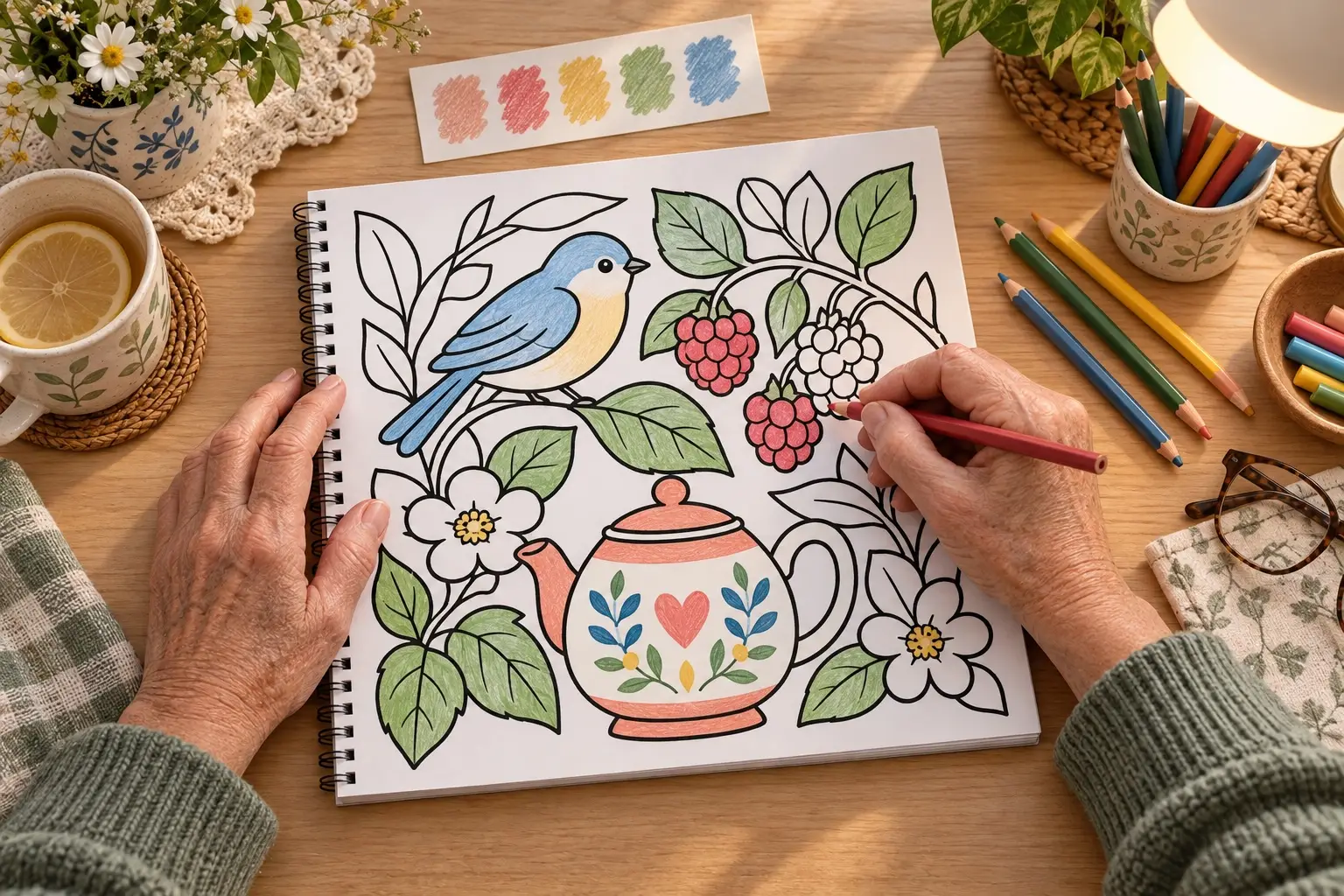
Choose by use case
If you wantSeniors who want a lay-flat book with varied nature subjects and removable pages

Large Print Easy Color & Frame: Peaceful
Best overallResearch-based reviewThirty-one large-print nature pages use a spiral binding, one-sided printing, perforations and a documented thicker-paper format
If you wantSeniors who enjoy familiar vintage objects from the 1950s through the 1970s

Simply Nostalgic: A Bold & Easy Coloring Book (Large Print)
Best nostalgic themeResearch-based reviewThirty-one large, bold illustrations feature objects such as a jukebox, lava lamp, roller skates and sewing machine on single-sided perforated pages
If you wantColorists who want simple plants, animals and outdoor motifs rather than household objects

Simply Stress-Free: A Bold & Easy Coloring Book (Large Print)
Best nature varietyResearch-based reviewThirty-one nature-inspired designs use big shapes, minimal detail and single-sided perforated pages in a 9-inch-square format
If you wantColorists who want one clear botanical theme and large repeated shapes

Simply Berries & Cherries: A Bold & Easy Coloring Book (Large Print)
Best focused subjectResearch-based reviewThirty-one big, bold berry and cherry illustrations use a lay-flat, single-sided and perforated 9-inch-square format
If you wantSeniors who prefer a defined palette and step-by-step color key

Brain Games Color by Number Large Print: Patterns
Best color by numberResearch-based reviewTwenty-seven large-print floral and geometric images pair numbered cells with a color swatch key, perforated one-sided pages and spiral binding
Product comparison
| Product | Best for | Watch out | Price & shop |
|---|---|---|---|
| Large Print Easy Color & Frame: Peaceful (opens Amazon in a new tab) Best overallResearch-based review | Seniors who want a lay-flat book with varied nature subjects and removable pages | The publisher says the pages range in complexity, so some designs may contain smaller spaces than the large-print label suggests; no exact paper weight is published | Budget-friendlyCheck price on Amazon (opens Amazon in a new tab) |
| Simply Nostalgic: A Bold & Easy Coloring Book (Large Print) (opens Amazon in a new tab) Best nostalgic themeResearch-based review | Seniors who enjoy familiar vintage objects from the 1950s through the 1970s | Nostalgia is personal rather than universal, and the bound paperback may need more hand pressure near the gutter than either spiral-bound pick | Budget-friendlyCheck price on Amazon (opens Amazon in a new tab) |
| Simply Stress-Free: A Bold & Easy Coloring Book (Large Print) (opens Amazon in a new tab) Best nature varietyResearch-based review | Colorists who want simple plants, animals and outdoor motifs rather than household objects | The paperback lacks a spiral binding, and neither Dover nor the Amazon edition states an exact paper weight or minimum shape size | Budget-friendlyCheck price on Amazon (opens Amazon in a new tab) |
| Simply Berries & Cherries: A Bold & Easy Coloring Book (Large Print) (opens Amazon in a new tab) Best focused subjectResearch-based review | Colorists who want one clear botanical theme and large repeated shapes | The deliberately narrow fruit theme offers less variety than the other free-coloring books, and no exact paper-weight figure is published | Budget-friendlyCheck price on Amazon (opens Amazon in a new tab) |
| Brain Games Color by Number Large Print: Patterns (opens Amazon in a new tab) Best color by numberResearch-based review | Seniors who prefer a defined palette and step-by-step color key | Color-by-number cells and printed numerals can add clutter for someone with reduced near vision, and the book offers only 27 images | Budget-friendlyCheck price on Amazon (opens Amazon in a new tab) |
How we researched this guide
- Product listings checked
- Hands-on testing
- None of the 5 picks — all are research-based
- Labels explained
- How we test and label products
This is a research-based buying guide, not a hands-on accessibility, paper or coloring test. On September 24, 2026, we opened each exact Amazon.com detail page in a US delivery context, confirmed the ASIN and edition, found an in-stock purchase path, and matched the listing to its direct Amazon CDN cover image. We cross-checked design counts, trim sizes, page layout, perforations, binding and themes against current Dover Publications and Publications International/New Seasons pages. We also reviewed current National Institute on Aging and National Eye Institute guidance before writing about lighting, contrast and low vision. KawaiiToons has not colored in these copies, measured line thickness or paper weight, tested page removal, marker bleed, glare or binding resistance, or assessed any book as a medical or therapeutic aid. Rankings therefore reflect documented format differences and practical fit, not invented accessibility scores.
Testing status by pick
- Large Print Easy Color & Frame: PeacefulResearch-based review
- Simply Nostalgic: A Bold & Easy Coloring Book (Large Print)Research-based review
- Simply Stress-Free: A Bold & Easy Coloring Book (Large Print)Research-based review
- Simply Berries & Cherries: A Bold & Easy Coloring Book (Large Print)Research-based review
- Brain Games Color by Number Large Print: PatternsResearch-based review
Product details and drawbacks
Large Print Easy Color & Frame: Peaceful (opens Amazon in a new tab)
Thirty-one large-print nature pages use a spiral binding, one-sided printing, perforations and a documented thicker-paper format

Why it fits this guide
Peaceful has the most practical all-round construction in this group. Publications International documents 31 pages featuring flowers, hummingbirds, the night sky and other subjects, so the book offers variety without becoming a random hundred-page assortment. The spiral lets the active page lie flat, while perforations make it possible to move a sheet to a clipboard, lap board or angled stand. The publisher says the paper is thicker and helps reduce bleed-through, but it does not publish a gsm figure or promise marker-proof performance.
Honest drawback
The publisher says the pages range in complexity, so some designs may contain smaller spaces than the large-print label suggests; no exact paper weight is published
Specifications
- Exact Amazon ASIN 1639388591 was in stock and sold by Amazon.com on September 24, 2026
- Thirty-one large-print coloring pages across flowers, hummingbirds, the night sky and other subjects
- Publisher documents 8-by-10-inch, one-sided perforated pages, thicker paper and spiral binding
Best forSeniors who want a lay-flat book with varied nature subjects and removable pages
Pros
- Spiral binding keeps the active page flat
- Perforations make sheets easier to reposition
- Varied nature subjects avoid a single-theme commitment
Cons
- Interior complexity is not identical from page to page
- Exact paper weight and marker limits are not published
Simply Nostalgic: A Bold & Easy Coloring Book (Large Print) (opens Amazon in a new tab)
Thirty-one large, bold illustrations feature objects such as a jukebox, lava lamp, roller skates and sewing machine on single-sided perforated pages

Why it fits this guide
Simply Nostalgic gives the page a clear subject before the first pencil is chosen. Dover and the exact Amazon edition document 31 vintage- inspired illustrations built from big shapes and clean lines, including recognizable household and leisure objects. That can make it a more thoughtful gift than a generic pattern book when the recipient already enjoys mid-century decor, sewing or music memories. The 9-inch-square format is easy to support, and single-sided perforated pages can be removed, but the paperback is not spiral-bound.
Honest drawback
Nostalgia is personal rather than universal, and the bound paperback may need more hand pressure near the gutter than either spiral-bound pick
Specifications
- Exact Amazon ASIN 0486855856 was in stock and sold by Amazon.com on September 24, 2026
- Thirty-one vintage-inspired illustrations in a 64-page large-print paperback
- Exact edition documents single-sided perforated pages and an approximately 9-inch-square trim
Best forSeniors who enjoy familiar vintage objects from the 1950s through the 1970s
Pros
- Familiar objects provide immediate palette ideas
- Big shapes and clean outlines reduce tiny-cell clutter
- Perforated pages can be removed for easier positioning
Cons
- Theme will not appeal to every senior
- Paperback binding does not lie as freely as a spiral
Simply Stress-Free: A Bold & Easy Coloring Book (Large Print) (opens Amazon in a new tab)
Thirty-one nature-inspired designs use big shapes, minimal detail and single-sided perforated pages in a 9-inch-square format

Why it fits this guide
Simply Stress-Free is the broadest nature-first choice. Dover describes 31 big, bold images with minimal detail, while the exact edition is labeled large type/large print and uses a 64-page square paperback. Nature gives the colorist familiar options—greens, florals, sky colors and warm earth tones—without forcing a strict key. The open shapes suit crayons, pencils or controlled marker fills. As with the other Dover books here, the useful format does not establish a specific line-width standard or guarantee that every design is equally easy to see.
Honest drawback
The paperback lacks a spiral binding, and neither Dover nor the Amazon edition states an exact paper weight or minimum shape size
Specifications
- Exact Amazon ASIN 0486855848 had a current Amazon.com offer with limited stock on September 24, 2026
- Thirty-one nature-inspired large-print designs in a 64-page book
- Dover documents a 9-by-9-inch paperback and big bold images with minimal detail
Best forColorists who want simple plants, animals and outdoor motifs rather than household objects
Pros
- Nature subjects offer flexible, familiar palettes
- Minimal detail is less visually busy than intricate adult coloring art
- Single-sided perforated pages support removal and display
Cons
- Bound format may need help staying open
- Paper weight and line dimensions are not published
Simply Berries & Cherries: A Bold & Easy Coloring Book (Large Print) (opens Amazon in a new tab)
Thirty-one big, bold berry and cherry illustrations use a lay-flat, single-sided and perforated 9-inch-square format

Why it fits this guide
Berries & Cherries removes most subject decisions. The 31 illustrations stay with fruit, leaves and related botanical forms, so a small set of reds, purples, greens and neutrals can work across the entire book. The publisher documents a 9-inch-square format with perforations and pages designed to lie flat. Repeated round fruit shapes can be filled with broad tools or shaded with pencils, but repetition is also the main limitation: anyone who wants animals, objects or changing scenes may tire of the theme.
Honest drawback
The deliberately narrow fruit theme offers less variety than the other free-coloring books, and no exact paper-weight figure is published
Specifications
- Exact Amazon ASIN 0486856135 was in stock and sold by Amazon.com on September 24, 2026
- Thirty-one big, bold berry and cherry illustrations in a 64-page large-print edition
- Publisher documents approximately 9-by-9-inch, single-sided perforated pages designed to lie flat
Best forColorists who want one clear botanical theme and large repeated shapes
Pros
- Repeated subject supports a small consistent palette
- Rounded fruit and leaf shapes are easy to understand at a glance
- Perforations allow finished pages to be removed
Cons
- Least varied theme in the shortlist
- Paper weight is not documented
Brain Games Color by Number Large Print: Patterns (opens Amazon in a new tab)
Twenty-seven large-print floral and geometric images pair numbered cells with a color swatch key, perforated one-sided pages and spiral binding

Why it fits this guide
Brain Games Patterns replaces open-ended color choice with a clear system. Each of the 27 images includes numbered cells and a swatch key, and the book supplies a full-color answer section at the back. The spiral binding and perforations are useful for handling, while the floral and geometric subjects offer more structure than the free- coloring picks. That structure is not automatically more accessible: printed numbers and cell boundaries add visual information, and some colorists may find repeated key checking slower than choosing colors.
Honest drawback
Color-by-number cells and printed numerals can add clutter for someone with reduced near vision, and the book offers only 27 images
Specifications
- Exact Amazon ASIN 1645589579 was in stock and sold by Amazon.com on September 24, 2026
- Twenty-seven floral and geometric color-by-number images with a color swatch key
- Publisher documents 8-by-10-inch, one-sided perforated pages, spiral binding and a full-color answer key
Best forSeniors who prefer a defined palette and step-by-step color key
Pros
- Printed color key reduces open-ended palette decisions
- Spiral binding and perforations improve page handling
- Answer key provides a reference without requiring exact imitation
Cons
- Numerals and cell divisions may be harder to see than plain bold line art
- Lowest design count in the group
Corrections
Spotted an error or outdated detail? Read how we handle corrections.
Related guides
Best Adult Coloring Books for Beginners
Five research-based adult coloring books for beginners, compared by artwork density, page format, paper details, portability and theme.
Best Color-by-Number Books for Adults
Seven research-based adult color-by-number books compared by detail, theme, page format, binding, color keys and fit for pencils or markers.
Best Colored Pencils for Adult Coloring Books
Compare 10 colored-pencil sets for adult coloring books by core feel, color range, detail control, layering, paper fit, storage and replacement options.
Best Cozy, Bold and Easy Coloring Books
Six research-based cozy, bold and easy coloring books compared by subject, page count, format, paper disclosure and marker practicality.


