
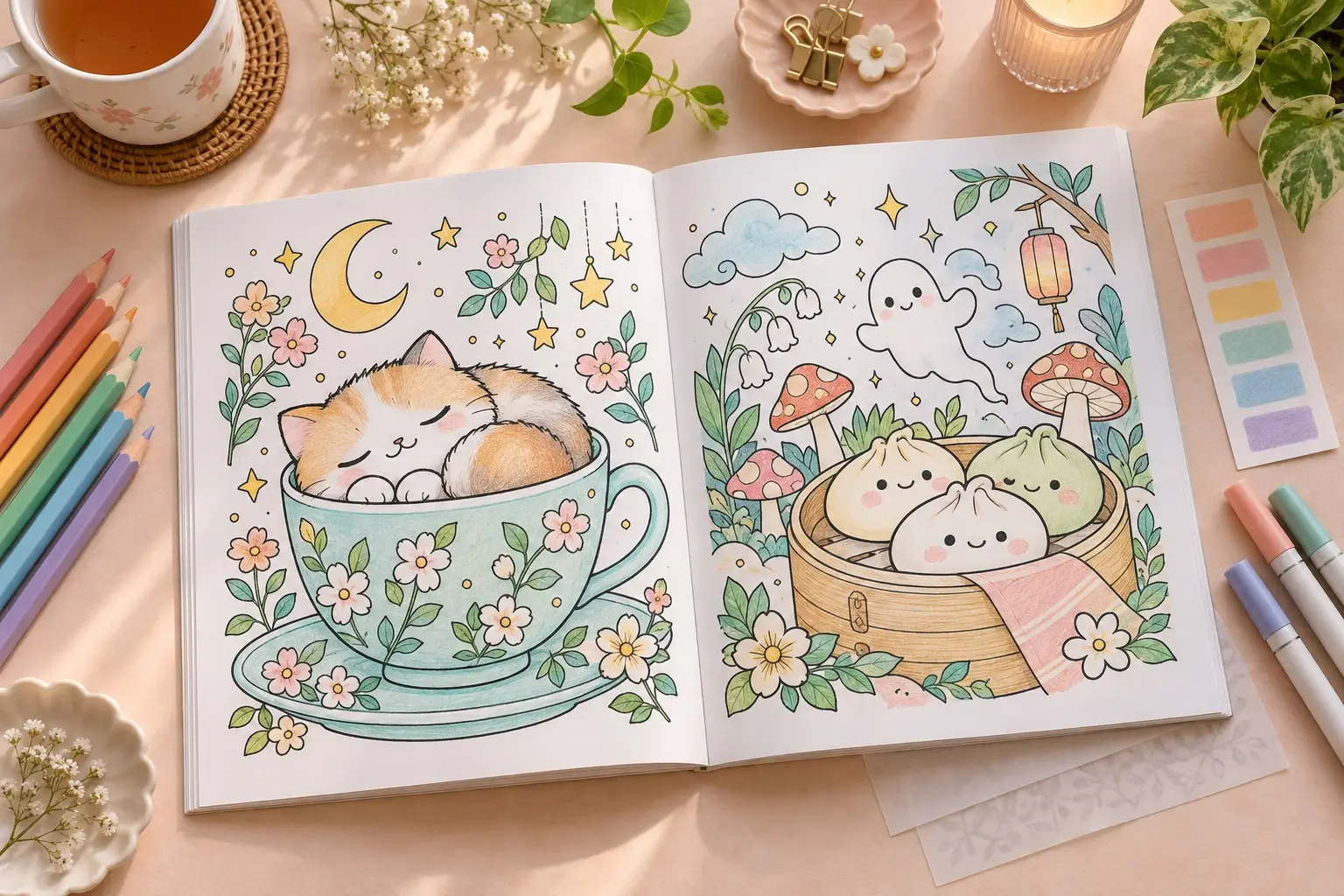
Choose by use case
If you wantColorists who want a broad tour of kawaii food, animals, settings and short visual stories

The Super Kawaii Coloring Book
Best overallResearch-based reviewA documented 124 scenes, characters and vignettes provide the widest creative range in this comparison
If you wantCat fans who enjoy Mofusand costumes, visual jokes and patterned scenes

Mofusand: An Official Coloring Book
Best official Japanese character bookResearch-based reviewOfficial illustrations place playful cats in shark, bunny, strawberry and bee costumes as well as food and everyday situations
If you wantFans of collectible-style characters, positive phrases and contrasting woodland and cosmic palettes

Official Momiji Coloring Book
Best two-theme conceptResearch-based reviewMore than forty exclusive single-sided illustrations split into Magical Meadow and Out of This World flip-book adventures
If you wantCat fans who want a deliberate mix of easy shapes and more detailed feline scenes

Kawaii Cats: 50 Purr-fectly Adorable Coloring Pages
Best cat-lover giftResearch-based reviewFifty hand-drawn cat pages range from yarn play and snacks to fanciful scenes with both quick and more involved compositions
If you wantOlder teens and adults who actively like manga-influenced portraits, monsters and surreal spooky detail

Pop Manga Cute and Creepy Coloring Book
Best detailed pickResearch-based reviewCamilla d'Errico's artist-led adult book combines monster girls, ghosts, undead figures, double-page scenes and decorative patterns
If you wantColorists who want cute animals in tea, market, park, blossom and everyday street settings

Kawaii Japan by Chickie Cafe
Best Japan-inspired scenesResearch-based reviewForty compact single-sided scenes pair approachable animals with Japanese-inspired food, places and daily activities
Product comparison
| Product | Best for | Watch out | Price & shop |
|---|---|---|---|
| The Super Kawaii Coloring Book (opens Amazon in a new tab) Best overallResearch-based review | Colorists who want a broad tour of kawaii food, animals, settings and short visual stories | The broad assortment is less cohesive than a cat, character or Japan-themed book, and the publisher does not document single-sided printing or exact paper weight | Budget-friendlyCheck price on Amazon (opens Amazon in a new tab) |
| Mofusand: An Official Coloring Book (opens Amazon in a new tab) Best official Japanese character bookResearch-based review | Cat fans who enjoy Mofusand costumes, visual jokes and patterned scenes | The appeal depends on liking Mofusand's specific cat-character world, and the publisher does not document perforations or an exact paper weight | |
| Official Momiji Coloring Book (opens Amazon in a new tab) Best two-theme conceptResearch-based review | Fans of collectible-style characters, positive phrases and contrasting woodland and cosmic palettes | Printed affirmations will not suit colorists who prefer image-only line art, and the publisher does not give a gsm figure or promise marker-proof pages | |
| Kawaii Cats: 50 Purr-fectly Adorable Coloring Pages (opens Amazon in a new tab) Best cat-lover giftResearch-based review | Cat fans who want a deliberate mix of easy shapes and more detailed feline scenes | The single subject can become repetitive for a colorist who wants food, fantasy and people, and the paper claim still needs a real marker test | Budget-friendlyCheck price on Amazon (opens Amazon in a new tab) |
| Pop Manga Cute and Creepy Coloring Book (opens Amazon in a new tab) Best detailed pickResearch-based review | Older teens and adults who actively like manga-influenced portraits, monsters and surreal spooky detail | Spooky imagery and dense patterned compositions are not universally teen-appropriate or beginner-friendly, and some double-page art may be awkward near the binding | |
| Kawaii Japan by Chickie Cafe (opens Amazon in a new tab) Best Japan-inspired scenesResearch-based review | Colorists who want cute animals in tea, market, park, blossom and everyday street settings | The smaller page gives crowded market or interior details less working room, and marker users still need a barrier behind the active sheet | Budget-friendlyCheck price on Amazon (opens Amazon in a new tab) |
How we researched this guide
- Product listings checked
- Hands-on testing
- None of the 6 picks — all are research-based
- Labels explained
- How we test and label products
This is a research-based buying guide, not a hands-on paper, print or marker test. On September 28, 2026, we opened each exact Amazon.com detail page in a US delivery context, confirmed the ASIN or ISBN-derived ASIN, an in-stock offer with add-to-cart and buy-now controls, and a matching direct Amazon CDN cover image. We cross-checked illustration counts, themes, page format, dimensions, audience positioning and published media guidance against current Tuttle Publishing, Penguin Random House, Andrews McMeel, Cider Mill Press and Hachette Book Group pages. KawaiiToons has not colored in these copies or measured paper weight, print contrast, line width, pencil tooth, marker bleed, show-through, perforation strength or binding durability. Rankings reflect documented creative and format differences, not customer ratings, temporary prices or claims that coloring treats stress or another health condition.
Testing status by pick
- The Super Kawaii Coloring BookResearch-based review
- Mofusand: An Official Coloring BookResearch-based review
- Official Momiji Coloring BookResearch-based review
- Kawaii Cats: 50 Purr-fectly Adorable Coloring PagesResearch-based review
- Pop Manga Cute and Creepy Coloring BookResearch-based review
- Kawaii Japan by Chickie CafeResearch-based review
Product details and drawbacks
The Super Kawaii Coloring Book (opens Amazon in a new tab)
A documented 124 scenes, characters and vignettes provide the widest creative range in this comparison

Why it fits this guide
The Super Kawaii Coloring Book is the most useful starting point when “cute” is the preference but the exact subject is still open. Tuttle documents 124 original scenes, characters and vignettes by illustrator Abbie Quirk, including a dinosaur daycare, a giant bento box, a candy mountain, fantasy sea creatures and a honeybee world. That variety lets a colorist switch between food, animals and environmental scenes without changing books. It is also the largest collection here, although volume does not make every page equally appealing or establish anything about marker performance.
Honest drawback
The broad assortment is less cohesive than a cat, character or Japan-themed book, and the publisher does not document single-sided printing or exact paper weight
Specifications
- Exact Amazon ASIN 4805318201 was in stock with add-to-cart and buy-now controls on September 28, 2026
- Tuttle documents 124 scenes, characters and vignettes across 128 pages
- Publisher lists an 8.5 by 9.5 inch paperback and an all-ages, all-abilities audience
Best forColorists who want a broad tour of kawaii food, animals, settings and short visual stories
Pros
- Broadest subject mix and highest documented illustration count
- Original settings encourage many different palettes
- Vignettes and fuller scenes support varied project lengths
Cons
- Less thematic continuity than the focused picks
- Paper construction and marker limits are not documented
Mofusand: An Official Coloring Book (opens Amazon in a new tab)
Official illustrations place playful cats in shark, bunny, strawberry and bee costumes as well as food and everyday situations

Why it fits this guide
Mofusand offers the clearest licensed Japanese-character choice in the shortlist. Random House Worlds documents playful, productive and sleepy cats dressed as sharks, bunnies, strawberries and bumble bees, plus scenes such as a sushi-making cat and a cat napping in a soda float. Costumes and repeated patterns create more palette variety than a book of cat portraits alone. The compact 8-inch-square format is easy to support, but the exact page count refers to the whole book rather than a published number of colorable designs.
Honest drawback
The appeal depends on liking Mofusand's specific cat-character world, and the publisher does not document perforations or an exact paper weight
Specifications
- Exact Amazon ASIN B0GT7HK84Z was in stock with add-to-cart and buy-now controls on September 28, 2026
- Random House Worlds lists an 80-page, 8-inch-square official edition
- Publisher describes original illustrations, detailed patterns and thick paper
Best forCat fans who enjoy Mofusand costumes, visual jokes and patterned scenes
Pros
- Official character art rather than a generic imitation
- Costumes, food scenes and patterns provide strong palette prompts
- Compact square format fits a smaller desk
Cons
- Narrower appeal outside the Mofusand fandom
- No documented perforations or gsm figure
Official Momiji Coloring Book (opens Amazon in a new tab)
More than forty exclusive single-sided illustrations split into Magical Meadow and Out of This World flip-book adventures

Why it fits this guide
Official Momiji has the strongest internal structure. One direction opens into flowers and woodland friends in Magical Meadow; flipping the book enters an Out of This World section with stars, moons and cosmic imagery. Andrews McMeel documents more than forty exclusive illustrations and single-sided pages intended for markers, gel pens and colored pencils. That makes the choice easy for someone who enjoys collectible characters and positive phrases, but the affirmations are a design feature rather than removable editorial copy.
Honest drawback
Printed affirmations will not suit colorists who prefer image-only line art, and the publisher does not give a gsm figure or promise marker-proof pages
Specifications
- Exact Amazon ASIN B0FWZXNPMV was in stock with add-to-cart and buy-now controls on September 28, 2026
- Andrews McMeel documents more than forty exclusive illustrations across eighty pages
- Two-in-one flip format separates Magical Meadow from Out of This World
Best forFans of collectible-style characters, positive phrases and contrasting woodland and cosmic palettes
Pros
- Two distinct palettes and moods in one book
- Official Momiji character artwork
- Single-sided format supports a barrier behind wet media
Cons
- Affirmation text is part of the artwork
- Exact paper weight and removability are not published
Kawaii Cats: 50 Purr-fectly Adorable Coloring Pages (opens Amazon in a new tab)
Fifty hand-drawn cat pages range from yarn play and snacks to fanciful scenes with both quick and more involved compositions

Why it fits this guide
Kawaii Cats is the simplest gift decision for someone whose main request is “cute cats.” Cider Mill Press documents fifty hand-drawn pages that range from easy-to-color shapes to more detailed compositions, so the book is not locked into one difficulty. Its single-sided pages are designed to be easier to remove and display. The publisher also calls the paper high-quality and intended to prevent bleed-through, but without a gsm figure or tool-specific test that language should not be treated as an absolute guarantee.
Honest drawback
The single subject can become repetitive for a colorist who wants food, fantasy and people, and the paper claim still needs a real marker test
Specifications
- Exact Amazon ASIN 1400355095 was in stock with add-to-cart and buy-now controls on September 28, 2026
- Cider Mill Press documents fifty coloring pages in a 112-page edition
- Hand-drawn illustrations vary from open shapes to detailed compositions and are printed single-sided
Best forCat fans who want a deliberate mix of easy shapes and more detailed feline scenes
Pros
- Clear gift match for cat lovers
- Built-in range from quick pages to longer projects
- Single-sided artwork simplifies isolation from the next design
Cons
- Less subject variety than the mixed books
- Publisher bleed-through language is not a universal media guarantee
Pop Manga Cute and Creepy Coloring Book (opens Amazon in a new tab)
Camilla d'Errico's artist-led adult book combines monster girls, ghosts, undead figures, double-page scenes and decorative patterns

Why it fits this guide
Pop Manga Cute and Creepy is the strongest step away from bold simple faces. Penguin Random House describes Camilla d'Errico's manga- influenced Pop Surrealism, including monster girls, ghosts, undead figures, spooky double-page spreads and wallpaper-like patterns. Large pages support layered colored-pencil work and complex palettes, while the recognizable artist style gives the book a clear identity. The same density and subject matter make it the pick that most needs an interior preview before buying for a teen.
Honest drawback
Spooky imagery and dense patterned compositions are not universally teen-appropriate or beginner-friendly, and some double-page art may be awkward near the binding
Specifications
- Exact Amazon ASIN 1984858491 was in stock with add-to-cart and buy-now controls on September 28, 2026
- Penguin Random House lists an eighty-page adult coloring book at approximately 9.8 inches square
- Documented subjects include monster girls, ghosts, undead figures, double-page scenes and wallpaper-like patterns
Best forOlder teens and adults who actively like manga-influenced portraits, monsters and surreal spooky detail
Pros
- Most distinctive artist-led visual language here
- Large format supports intricate portrait and pattern work
- Darker theme expands kawaii beyond pastel cozy scenes
Cons
- Requires more precise tools and time
- Subject matter needs an individual teen-content check
Kawaii Japan by Chickie Cafe (opens Amazon in a new tab)
Forty compact single-sided scenes pair approachable animals with Japanese-inspired food, places and daily activities

Why it fits this guide
Kawaii Japan has the most direct connection between a cute visual style and an identifiable setting. Hachette documents animals enjoying tea, markets, parks, cozy homes and streets lined with cherry blossoms. The 7.8-inch-square format is the smallest here, which helps portability but gives dense props less room. The publisher explicitly recommends a protective sheet when markers are used; that practical warning is more useful than a vague claim that single-sided pages cannot bleed.
Honest drawback
The smaller page gives crowded market or interior details less working room, and marker users still need a barrier behind the active sheet
Specifications
- Exact Amazon ASIN 1454966459 was in stock with add-to-cart and buy-now controls on September 28, 2026
- Hachette documents forty unique illustrations across eighty pages
- Single-sided 7.8-inch-square pages feature animals in Japan-inspired everyday scenes
Best forColorists who want cute animals in tea, market, park, blossom and everyday street settings
Pros
- Strongest place-based theme in the shortlist
- Compact size is easy to support or carry
- Publisher states clear protective-sheet guidance for markers
Cons
- Smallest working area in the comparison
- The theme is narrower than a broad kawaii collection
Corrections
Spotted an error or outdated detail? Read how we handle corrections.
Related guides
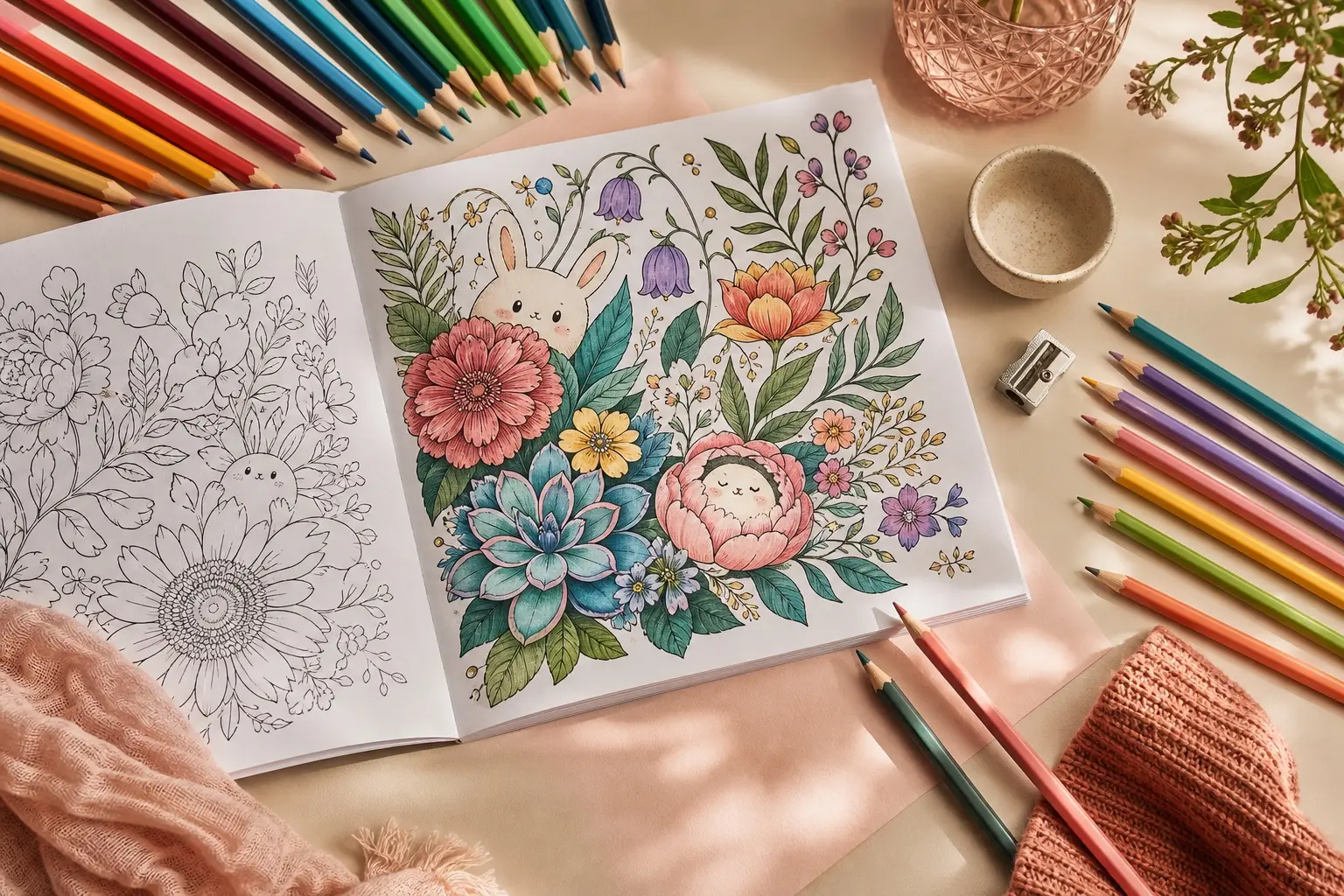
Best Colored Pencils for Adult Coloring Books
Compare 10 colored-pencil sets for adult coloring books by core feel, color range, detail control, layering, paper fit, storage and replacement options.
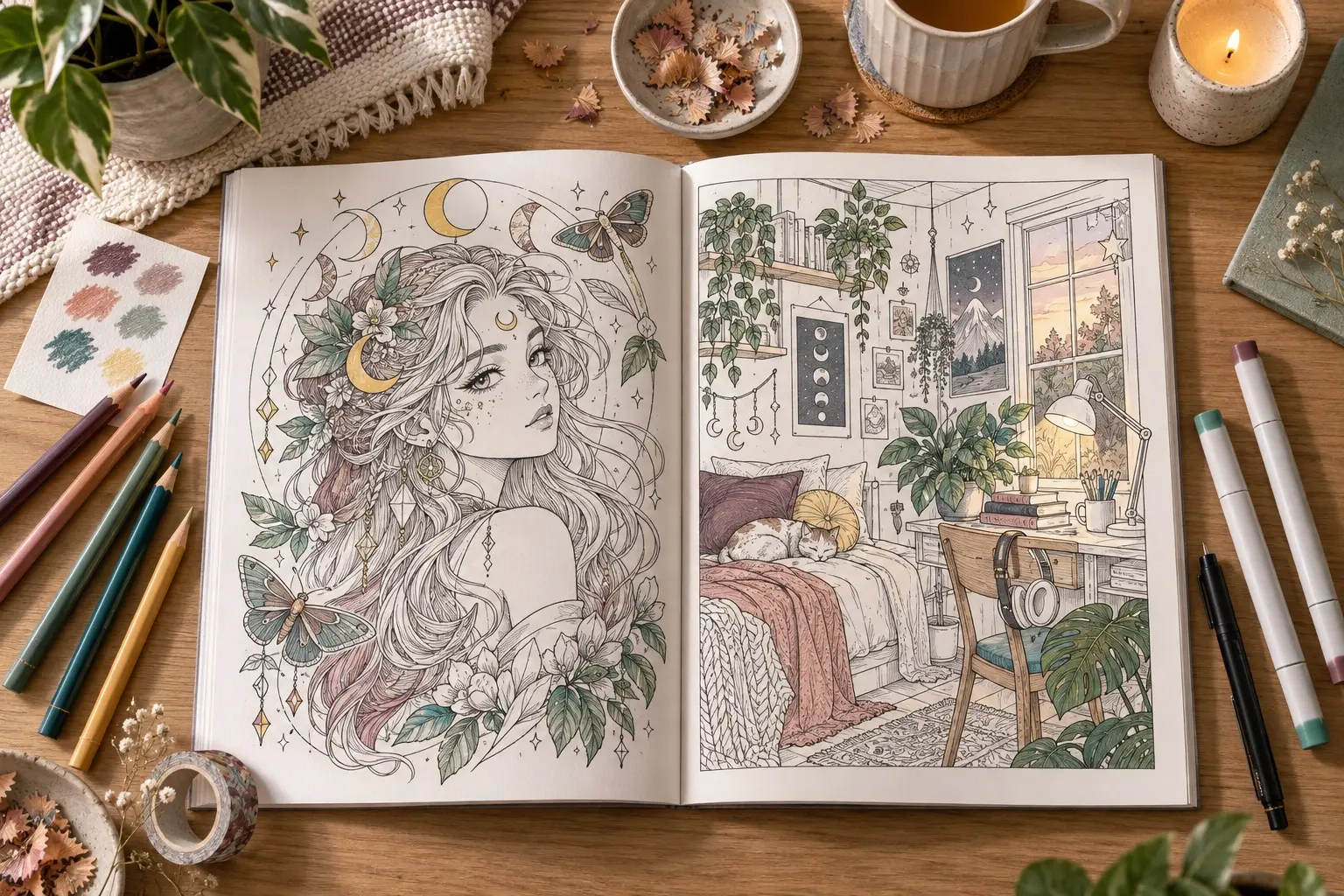
Best Coloring Books for Teens
Six research-based coloring books for teens, compared by theme, detail level, page format, paper disclosure and fit for pencils, pens or markers.
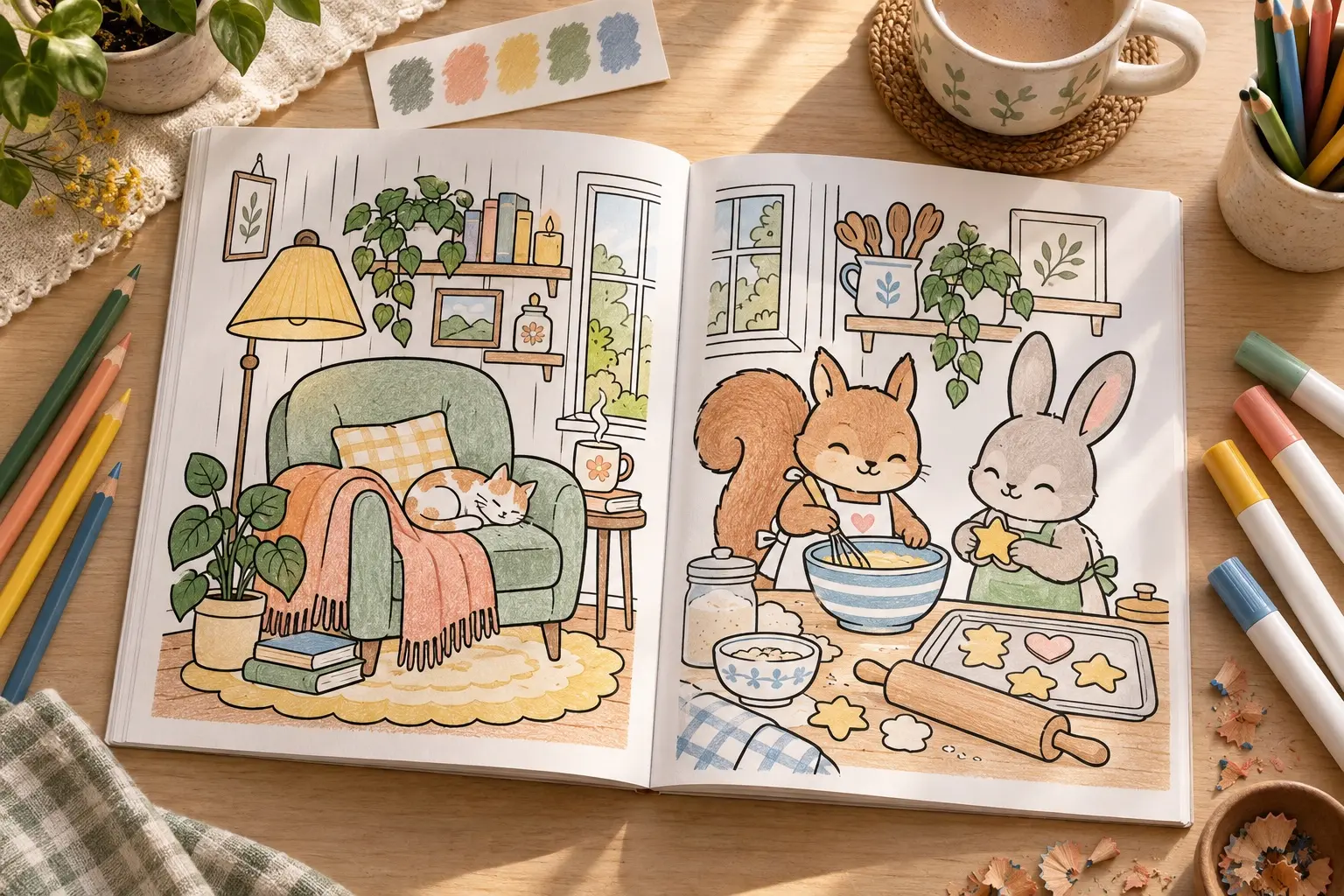
Best Cozy, Bold and Easy Coloring Books
Six research-based cozy, bold and easy coloring books compared by subject, page count, format, paper disclosure and marker practicality.
Best Water-Based Markers for Coloring Books
The best water-based markers for coloring books, including low-bleed dual-tip, brush and fineliner picks. Compare tips, colors and paper use.


